Episode Transcript
[00:00:04] Speaker A: There are different ways people with a special interest in language identify themselves depending on their focus.
Linguists, translators, philologists, interpreters.
But what do we call them collectively?
What name can we give to people who simply love talking about language?
To people who find joy in arguing about words, meanings, and terminology?
Should we call ourselves linguists, language workers, language professionals, perhaps?
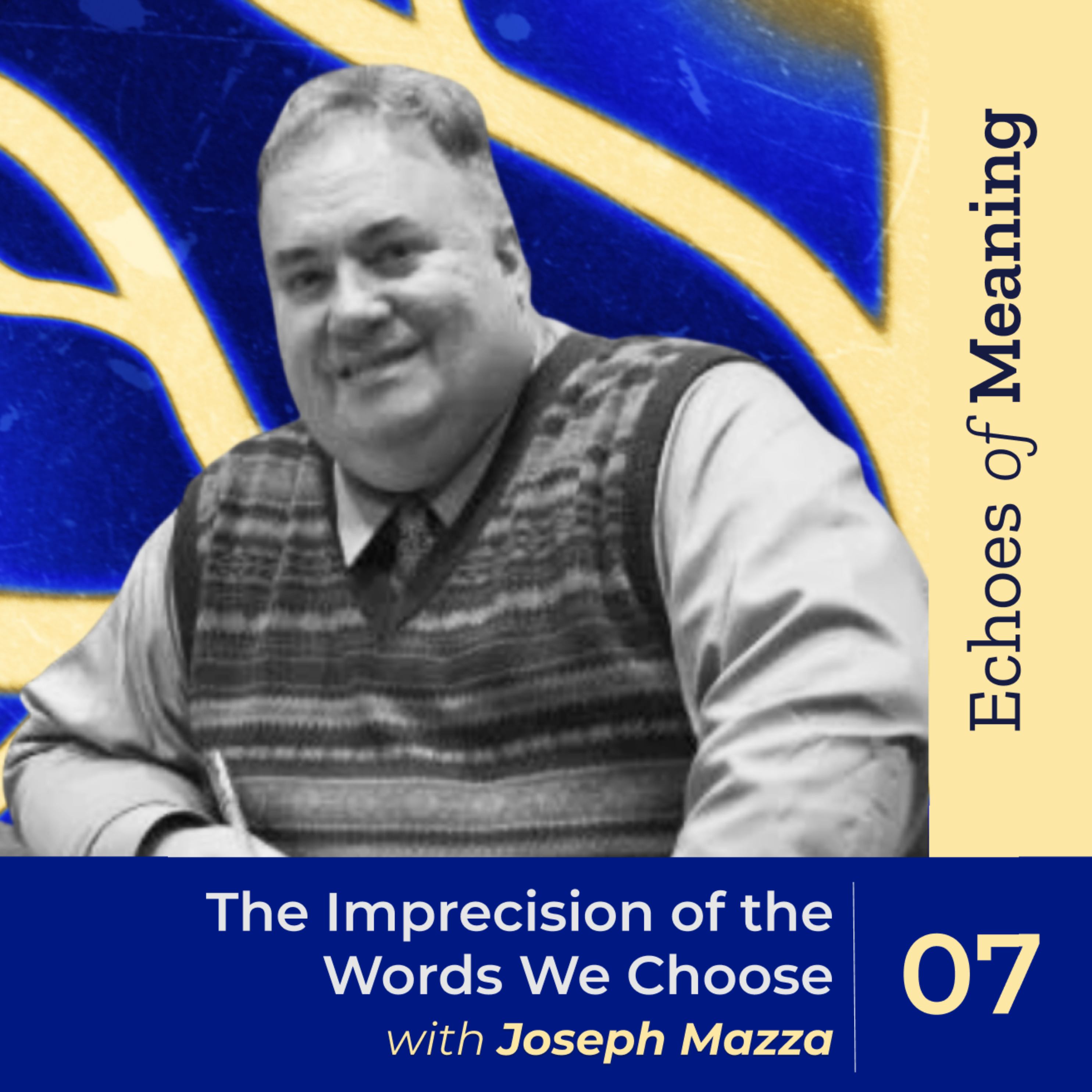
Well, we'll talk about that today, among other things, with our guest, Joseph Matzah, who spent more than four decades in federal government service, including serving as a chief of the Translating division at the U.S. state Department's office of Language Services.
He studied French, Spanish, Russian, Chinese, Chinese, Arabic, Portuguese, and Italian. His career took him from the US Navy's translation unit to work on the Comprehensive Nuclear Test Ban Treaty in Geneva. Today, he continues to dabble incessantly in learning languages he will never have time or brain space to master.
This was a fun conversation.
Thanks, Joe.
Welcome, everybody, to Echoes of Meaning.
[00:01:32] Speaker B: They have launch in Peru, which is, you know, afternoon break. Not every day, but I like being invited to a launcher because I know that you won't have a ton to eat. It's just moderate food, really light food and tea. And sometimes that's really refreshing because a lot of times the meals are very big.
[00:01:55] Speaker A: And talking about meals, you like gastronomy, right? I mean, you're a translator.
[00:02:00] Speaker B: I hope you asked the question about gastronomy. Yes.
Beyond language, it's a huge interest in my. As a cultural endeavor. Absolutely. Yeah.
I think it's one of the great.
The table. The dining table is one of the great transmitters of language and culture.
[00:02:23] Speaker A: I agree.
[00:02:24] Speaker B: In.
[00:02:25] Speaker A: I don't know if in Peru, but in Colombia, we have this word sobremesa.
[00:02:29] Speaker B: It's a huge word. It's a huge cultural buzzword. Yeah. It's hard to translate right into. Into the English of the United States right now, where a lot of times people are not even taking the time to sit down together as a family and. And eat an evening meal, let alone, you know, they're not home to have the midday meal. And that's just the thing of the past. So. Sobre mesa. Yeah. I mean, but people identify with it. Every family is different. There are so many cultures within the United States. Some cultures don't recognize it. Like, wow, what a concept. Other cultures. Absolutely. Within the United States, too. So, you know, generalization is so difficult when we talk about language and culture. Right.
[00:03:11] Speaker A: I agree.
Can you introduce yourself and tell me a little bit about your background? Sure.
[00:03:18] Speaker B: My name is Joseph Maza.
I'm happy to be here today on this Podcast with Camilla I, for several decades, worked at the Department of State's Office of Language Services. It's one of the oldest language service providers in the world, going back to 1781, and I was proud for the last few years to have been the chief of its translating division. I retired in 2024, and since then I've been teaching and enjoying language. And I think that that's going to be the crux of what we're going to talk about today with Camila. I can probably go into more detail, but that may come out through the course of the podcast. So. So rather than bore you with a list of achievements, I will let those come out gradually and we'll jump into the topic of the day.
[00:04:15] Speaker A: Thank you for the, for the roundup.
I appreciate, you know, like, that kind of acknowledgment of the rhythm of the conversation and that.
You are enjoying language, as you said,
[00:04:34] Speaker B: in a new way, when you are not working in language from 9 to 5 or whatever the hours may be. Yes, it does change your perspective on language. It gives you more time to savor words and languages and the way humans use language and to take deep dives, perhaps more often.
So I'm enjoying this part of life and learning languages in a new way, revisiting ones that I abandoned along the way and trying to make amends with them.
And, yeah, I think that's something we'll talk about a lot today.
[00:05:17] Speaker A: So beautiful.
You mentioned, you said that you were a language nerd with. You were little.
[00:05:25] Speaker B: I was. I don't think we had a turn for it. I wish we had.
But, yes, going back now, yes, I was an incurable language nerd from my earliest memories. Yes.
[00:05:39] Speaker A: And how was it? I mean, how can you describe. You were a language nerd? What, what were your, your habits or what did you do that made you a language?
[00:05:47] Speaker B: It started by always trailing behind my grandparents. I had the privilege of having grandparents who spoke on my dad's side, the Sicilian version of Italian, and on my mom's side, Polish.
And so I won't say I'm a heritage speaker of audio language because I didn't live with my grandparents. So that just made me all the more curious. So I would incessantly ask them how to say different things in their languages. And it was interesting because now that I look back, sometimes my questions were really hard. I wasn't very good at picking what words to ask because I didn't have the cultural sensitivity. So, you know, we played with something called Lincoln Logs when we were kids. In the 1960s in suburban United States. And I would ask them, how you say Lincoln Logs in Sicilian or Polish? And they would just.
No idea. They would probably give me a word for toy.
But I remember once I asked my grandmother, my Sicilian grandmother, how do you say steak in Italian? She never.
She spoke in Italian, Sicilian, Italian. She never seemed to use a word for steak. And I said, how do you say it? And she looked at me quizzically and then she looked at her husband who also spoke Sicilian. And they said, which is not a word of an English word. But I looked later and researched it a little bit. And, you know, big slabs of meat like that on the plate were not so much a thing in Sicilian culture of the time, Especially if you came from an agrarian family.
You know, meat was expensive and you didn't necessarily have it in one huge piece on your plate. You probably chopped it up, ground it up, and made it go farther. So it was a word that maybe never existed in at least their vocabulary. I'm sure if you went to an aristocratic house in Palermo in 1910, they would have had a good word for it. But my grandparents did not. And that has all kinds of cultural ramifications why they were not able to ask. So naturally in high school and in college, I took as many language courses as I could.
But I had this feverish hope of being a multi polyglot, right? One who speaks many, many languages. And that didn't really happen.
Every time I would decide, no, you have to concentrate on just a few, I would just fall off the wagon and begin dabbling in other languages.
So I made my peace with that, that I will concentrate on some languages.
[00:08:27] Speaker A: I.
[00:08:28] Speaker B: But I remain open to learning a few words in any language. It's.
That's what a language word, language nerd does.
[00:08:38] Speaker A: And how did it continue from there? Like, what did you do to continue your journey with language?
[00:08:45] Speaker B: And I'm so lucky because my best friend in high school was also a language nerd. And she eventually found a job in the government as a translator. And we had lost touch in college, and she called me up one day out of the blue and said, hey, you're getting ready to graduate. I'm sure you have a career lined up.
I have no career lined up. Oh, well, would you like to come and interview for a clerk translator position?
Clerk translator. It's an interesting sort of entry level profession in the US Government for a translator. And you're helping the other translators, you're doing research. But as it turned out, from day one, they had Me translating, and quickly converted me to a translator here in simple. So that was with the Department of the Navy. And I had studied Russian and Romance languages and Chinese in college.
They were very interested in the Russian at the time because it was the Cold War. And I don't know if this is the time you want to go into the Cold War Translator spiel. Okay.
It's funny, because I realize now that we're going on two generations who grew up without the Cold War being part of their daily existence. But in my generation, in generations past, it was the accepted reality of the world. And indeed, one of the big questions was, is this the way the world will always be? Will it always be bipolar? United States versus the Soviet Union, Warsaw Pact versus NATO? And it's funny, because when you asked intellectuals at the time, the answer that I most often got was, yes, it will always be this way. It's too ossified.
But when I asked people who were less well educated, I remember I asked a lady from Germany who was a cleaning lady. I asked her, do you think it'll always be this way? And she said, absolutely not.
This is just a fluke, and we'll change. And she actually wound up being right, because within a few years, we watched that construct in world politics completely evaporate, and with it, the jobs of many Russian translators. But we were going strong for a while, and we were. Russian translators were really sought after by the US Government.
A lot of my mentors, I should mention, had amazing mentors at the Navy. Many of them had started out as German linguists, some of them right after World War II. And I think the government steered them into Russian because they're both languages with rich declension systems. And that can be very frustrating for folks who are studying languages without declension systems.
And so it seemed like a good fit. Well, they always were good in German and Russian, and many of them had Romance languages on the side. The wonderful thing about that Navy office was you were encouraged to work in as many languages as you could safely work in safely, meaning you probably needed a reviewer. And so I remember I walked in the first week and I was given a Portuguese text translate. I think said, oh, but I've never studied Portuguese. I said, it's okay. You'll just piece it together and take it to this gentleman who knows Portuguese really well, and he'll help you. This is Portuguese into English. I thought that was an odd approach, but I went with it. And I got through the translation. And, yes, it was marked up because, number one, I was Just getting started as a translator. And number two, yes, I didn't know Portuguese, but then I set about to study Portuguese and became somebody who could really say they were a Portuguese translator. But I kind of like that attitude. As long as you have the safety net, right?
Most of the work we were doing was called. This is a great Cold War term. I think it may have survived open source literature exploitation. Sounds scary. It just means you go through magazines and newspapers and other publicly available forms of information.
Mind you, there's no Internet at this point time. And you look for items of interest. For the Navy, obviously it was items of naval interest. And so it was mostly looking at Soviet newspapers. Pravda, Istia, Red Star, Krasnyzdesda was the magazine, the newspaper of the Ministry of Defense. So you read those every day and you combed through them to find as many articles of naval interest. And then you translated them or given extract of them.
[00:13:20] Speaker A: You were feeding yourself with culture, basically.
[00:13:23] Speaker B: Well, so here's what I wanted to say about that. These were tough years. This was the 1980s, when I was a Russian translator during the Cold War were cold years. Within the Cold War, there had been an era of detente in the 70s, but things got cold again after the Soviets invaded Afghanistan in 1980.
So there was not the same warmth or even cold contact between the United States and the Soviet Union. It was a time when the Soviet press was extremely formulaic, not so creative. You were expected to follow certain protocols. And boy, if we had machine translation, it would have been great because articles really were cookie cutter. And one of the articles that we looked at a lot were visits between leaders of the Warsaw Pact, Soviet leader visits, the Polish leadership, or the East German leadership or the Czechoslovak leadership. And those were always written in a very formulaic style. They would always say that they held their discussions in an atmosphere of socialist brotherhood. So, you know, if you say that literal translation, the discussions took place in an atmosphere of socialist brotherhood. How do you make that sound catchy in English, right? You say socialist brotherhood permeated the talks. Do you say, wow, you could really feel the socialist brotherhood in the room when they were talking? No, you can't say that. You often wind up using things that sound just as formulaic in English as they do in the source text. And that gives a certain chill to it, a certain rigidity to the whole processing of the experience when you're reading this in English. And that was a challenge because it got rather monotonous after a while and you were sometimes tempted to depart from the Script and not be so formulaic in English. But somehow you were always nudged back into being formulaic. Well, the reason I'm telling this story is because one day in the late 80s, it was when Gorbachev, the new Soviet leader, visited East Germany.
Erich Honecker was the head of the Communist Party and East Germany then. And when they reported it in Prabden is Vista, they didn't use the formula. They just said they met.
And it sent a shiver down our spines because we thought, well, how could they not use the stock phrase? And sure enough, it was a very heated discussion. And soon after that, everything changed. I mean, the Cold War ended and the Berlin Wall came down and there was no more East Germany. Germany unified, just like the German clean lady said it would. And yes, there definitely was not a need. So much for Russian translation translators. At that time, I was lucky to find a new job at the State Department. I focused on romance languages and that became my career for the next 35 years or so.
But I have warm memories of those days in the Cold War. We used to call ourselves spracharbeiter, which is a made up German word. I think that one of my colleagues made it up language workers.
Because sometimes we felt like we were toiling like factory workers. You know, we were doing these little summaries of Russian articles. And I like that word. It made it sound very like honest, correct, proletarian work.
[00:16:57] Speaker A: You know, we don't have a word like that in Spanish. Like we don't have.
At least that I am aware of.
We have the word linguists and we spoke about that the other day.
But it doesn't cover the whole thing, I think, like language worker, of course, in English
[00:17:19] Speaker B: and it's, you know, a Germans will, will look at you crazy, doesn't think you're crazy.
[00:17:24] Speaker A: If you say that it will be the. Yeah, it will be this.
Yeah, that would be the equivalent in German.
But of course, I think it's a very noble term.
[00:17:39] Speaker B: What do we call ourselves? And that's a huge question. Do we call ourselves translators, interpreters, linguists, Language professionals, Language specialists? There's one out there called philologist, which, which is not used very much anymore. But it's a great word, right? It's a lover of language. A word lover perhaps, but not used in professional circles. So, you know, linguist is a word often applied in government circles to translators and interpreters. It has the advantage of being one word that covers two skills. A lot of places in the government will ask that you either be a translator or an interpreter. So some places will allow you to do both and places need you and encourage you and hire you to do both. So linguist winds up being useful, except that when you go out and speak in public about your profession, if you refer to yourself as a linguist, you may incur the wrath of other people who call themselves linguists, namely students and teachers of linguistics, which is obviously a very well established academic discipline. It was an older medium, older. Many of linguists, I think it goes back to the 17th century. It's just a person who's interested in language, who studies them, who makes them his or her life work.
So it's a very flexible word. I always liked language professional.
Sometimes I use the word word people.
Those aren't going to work in many cases.
[00:19:10] Speaker A: I like that one word people.
[00:19:13] Speaker B: It's very simple. Right.
[00:19:15] Speaker A: I love it.
[00:19:16] Speaker B: So it's ironic that we people who specialize in words and in language have sometimes difficulty finding a good title for ourselves.
[00:19:27] Speaker A: I agree. I was watching your lecture on philology that was in the Middlebury Institute.
[00:19:38] Speaker B: There was one recently you may have seen at the University in Maryland.
[00:19:42] Speaker A: Maryland. Yes.
Yes.
[00:19:45] Speaker B: That did that. I suppose, you know, philology or love of words would characterize that talk.
[00:19:52] Speaker A: Yes, yes. You were talking about being word orderers.
Orderers.
And you spoke a little bit about lexicology and about etymology, about.
[00:20:09] Speaker B: Yes.
[00:20:10] Speaker A: And it was funny because I've been thinking about that a lot lately, you know, about etymology.
And.
I've been thinking about the need to understand where words come from.
Yes, yes. And of course, like, like if you.
Hombre, I am going to say this.
To me, a linguist is not a person that necessarily studied linguistics. I studied linguistics, but it's not what makes me a linguist. You know, to me, a linguist is a person that has this fixation with language, with expression, and with symbolism in reality, basically, you know, and trying to go through that.
[00:21:01] Speaker B: Yes.
[00:21:02] Speaker A: And it's a lens. Right.
[00:21:08] Speaker B: And
[00:21:10] Speaker A: when we understand words as these conventions that carry this bunch of meaning that we take for granted, and not only words, but flags, but like clothing, everything. Everything is like this thing that is set right now.
[00:21:28] Speaker B: Yes.
[00:21:29] Speaker A: But if we go down, it was different before. It is there, like these roots, right, that they fragment.
[00:21:37] Speaker B: And
[00:21:39] Speaker A: when we start, let's go following the path of words, you start, like, deconstructing what words mean. And you can start looking at words like this weird stuff that has these components and this, I don't know, suffixes. Is that a.
[00:22:05] Speaker B: Well, yeah, I think that when you look at words, sometimes I look at them as cells. Right. So there is a core, meaning the nucleus.
But then there are lots of other little bits of baggage packed inside that word. So you imagine this sack of cytoplasm with the nucleus and lots of. I think they're called organelles. And that's a word to me, right? It carries all of that. But of course, words are wonderful, but they work so much better in combination. So those would be the tissues that different cells form. You can also look at atoms and molecules and compounds, and it's the same principle.
And I think that it is very instructive to use etymology as a tool for language learning. I mean, I do this all the time. So I'll give you an example. And this is a real life example, and it's only an hour old. So before I did this podcast, I knew I had to feed our pet rabbit because otherwise he could make noise and completely derail this conversation. So every morning he gets lettuce eat. And this shows what a word nerd I am. I'm going through the routine motion of giving him the lettuce, and I have a panic attack.
Why? I can't remember how to say lettuce in Italian. This bothers me. Right now I'm thinking, you know, it can't be latuga. It must be what. How do you say lettuce in Italian? So I quickly throw the lettuce item and run back to my computer. And. And it is lechuga in Italian, like lechuga in Spanish. Spanish in most languages, it comes. It's related to salad, and it comes from the word for salt. The root for lechuga is leche. It's milk. Because a lot of times these plants, when you cut the stalk, have a milky secretion.
At least that's what my source told me. That's connection, right? So how crazy is that, that lettuce and milk are connected? You would never think, just like in some languages, lettuce and salt are connected. Of course, I had to see how the Chinese say it, because oftentimes that's a whole nother etymological universe. And then the Chinese word spreads into Japanese and Korean and other languages.
So their basic word for lettuce is two components. One is the word for life, and the other is the word for food.
And so I thought that was an interesting combination. But then I had to do this podcast, so I couldn't explore it anymore. But that's the way I use language, for learning many languages at the same time. It doesn't mean I'm going to master all those languages, but it does mean that I try to look at how the word plays out across languages, and I try to try to build etymological trees and see how the word spreads. A lot of times the word will originate in India, and then it will go into Persian, into Arabic. Sometimes it'll stop short there, sometimes it'll go into Turkish, sometimes into the Balkans, but then it will stop in Western Europe and it will stop in the Far east, and another etymological tree will take over. Then there are words like coffee and tea. Basically, you know, coffee comes from some say an Arabic word, some say an Amharic word, but from somewhere over in that part of the world, and then it spreads to the entire world. And it's hard to find a language that doesn't have a word for coffee that doesn't come from that initial word, coffee. Obviously, it's different in Arabic or Amharic.
Curiously, Amharic replaced it with buna, which is a completely other word. It's one of the few major languages in the world where coffee doesn't have, you know, it's not the Kagan. Tea is almost always tea comes from Chinese word.
So, yes, etymology is hugely important. I will warn you. One of the great scholars, a French scholar of the 18th century, said that etymology is the science where vowels count for nothing and consonants for very little.
And it's because etymology, yes, it follows sometimes very scientific algorithms of phonetic shifts over the centuries, but there is sometimes an element of folk etymology. Right. Somebody says, well, it sounds like this, so it must be. That's where the word comes from. And sometimes it's really hard to prove.
Please.
[00:26:42] Speaker A: Like it's gossip.
[00:26:44] Speaker B: It's almost like gossip. And you will see it sometimes cloaked in academic study, but you will also see absolutely vitriolic debates about word origins. And sometimes they, especially if they touch on sensitive cultural or political issues, they can be very sensitive.
So I think you have to take everything with a grain of salt, of course, and I think a sense of wonder, curiosity, humor, and not expect too much. But the possibilities are fascinating. And when you correlate it with some of the studies on the peopling of the planet and how humanoids moved about the planet in the earliest days, you have some really fascinating stories to unravel.
[00:27:31] Speaker A: I agree. And like tracking. That was the word I was looking for, tracking all this evolution, to call it, somehow is a way to find out that we are one, that we are confident.
[00:27:47] Speaker B: Absolutely. And I think during this period of, you know, pure language enjoyment. Right. When I don't have the rigors of the office and where language is not being practiced as part of a very specific task, where one has to be very, very responsible and aware of the. Of the institutional norms. I don't have that anymore. So I've come to the. I won't say conclusion because I haven't gotten to the end yet, but I've come. I've started to feel that in some ways all languages are one. It's just one big language, all of the languages of the world. And that obviously is not the case. Right.
But I see sometimes more similarities than differences. And I see so much borrowing in the last 500, 600 years among languages that I do sometimes feel like it's all one language.
So if I am learning how to say lettuce in all these languages, it's almost like I'm just learning how different families in the same town say lettuce. Because, you know, in, in. In probably in your town, sometimes within families, people have ways of saying things that no other family says. Right. And you know, you're. That baffles the learner. Why the word that the family I know uses isn't used in other family. It's sort of a family code word. Right. And that's how I'm sometimes feeling about language right now, of course.
[00:29:16] Speaker A: And I mean, that's an another analogy that we can use. Like, within the same country, we have different regions, and within those regions we have different expression for same things. And within the same.
Little parts of those regions, we found another particularities. And until we get to the ideal, it's to the exactly individual expression of language, which is your own language, that you build yourself with your own experiences. So if you lived in different parts of the country, you have this particular ideology that. Anyway, I mean, I think we got it, but like the way we track words and how we can conclude that it is just one big thing expressing itself through time and through different cultures and people and regions.
[00:30:18] Speaker B: Well, it also invites us to look at how the concept is viewed in the culture. Right. A lot of what a translator and probably an interpreter also would have to do is build categories. So one is. I'll give you just an example, ceramics. You know, a classic subdivision of ceramics might be porcelain, stoneware, and earthenware, depending on the hardness of the. Of the ceramic in question.
And so that's not the way necessarily other cultures break down the idea of ceramics. Right. So you wind up often in translating, especially going for the generic. Right. Because you're not sure if the term you're seeing GRES in Spanish, for example. How much does that cover? Does it cover stoneware? And earthenware, for example, probably doesn't cover porcelain. So you wind up calling the thing ceramic, a piece of ceramics, because you're not quite sure of the subdivision. And you don't necessarily always have time to research the fine points of it. So you go for the generic. And yes, perhaps you lose a bit of precision, but depending on the context, depending on the constraints of the assignment, it may get you through.
And I think we do a lot of that, seeing how things like, for example, think of the fine arts. What are the subdivisions of the fine arts? Well, it's very culturally specific. Right. Some people might include photography, some people might say, oh, no, that's not fine enough to be a fine art.
And it's fascinating to see how cultures break these things down and to try to come up with a table of ranks, for example, can be very, very difficult. So you're always jumping around in different hierarchies of character, of categorization.
And that's something that now I think I have a little more time to do as well.
[00:32:07] Speaker A: That's beautiful. And I'm glad you have the time to do that because, I mean, with your experience and your knowledge and your curiosity is going to be amazing what you find out. And I want to interview you again, like in two years and see.
And see where you're at and see what you can share with us. But I think that another example of that is categorization, dynamics or phenomenon is.
Let me know what, what you know about this.
Like before, like hundreds of years ago, we didn't have a word.
I mean, in the old continent, they didn't have a word for blue because blue wasn't that of a common color because it was very expensive to create.
You needed a bunch of stones and very hard items so you can craft the ink or whatever it is that they use for the color blue.
And so the sky wasn't actually blue, it was purple. They called the color of the sky purple.
And the way, like, they group this.
Concept of what color is, make them see the sky as something blue, purple as something purple. And to me, it is impossible. And I think for us, it is impossible to comprehend the conception of color that they had before because it was.
Everything was like color, gray or earthy colors and even white colors.
[00:34:00] Speaker B: Or you have the words like colorado in Spanish, which sometimes meant red.
[00:34:06] Speaker A: Yeah.
[00:34:06] Speaker B: When you look at it, it just means something of color. Right. But what color are you talking about? Oh, you know, I can't say that I'm an expert in this at all. But you, you collide with this every time we try to learn the colors in a specific language. Especially if you go back over time. Yes. The words you shift and. Oh, it's fascinating and you know.
[00:34:28] Speaker A: Yeah, yeah.
[00:34:28] Speaker B: But may have more or less words for shades of color.
[00:34:33] Speaker A: Yes.
What I was going to is that for us it meant a switch or that terminological change was based on technological development because now we can produce the color blue and now we have a different perception of what blue is.
[00:35:00] Speaker B: Well, now we have numeric codes to tell us exactly what you were talking about that work across nations. Right. So it's very precise. Yes.
[00:35:08] Speaker A: Yeah, yeah, yeah. And what you were talking about with photography is the same thing like when communities don't have this device or are not very related to this device and it's possible that they are not attached or may not grab this instrument for self expression.
Of course, these people are not going to see photography as art, maybe.
Right.
Yeah.
[00:35:41] Speaker B: I think that it just reminds us how language is so tied up with culture and how learning a new language forces us to change our perception and to challenge our assumptions about life.
And sometimes that makes us frustrated, even angry. But most of the time it's a source of wonder and beauty, I think, to see how things play out across languages and culture.
[00:36:07] Speaker A: Yeah, that's what I was so fascinated with, your choice of words. Calling us word orderers.
The way you choose to. To use words definitely changes and defines your perception of what's going on.
[00:36:28] Speaker B: So the translator is a word order. In other words, we order words around.
We don't just put them in order, we order them around. I mean, they really are our tools, our arsenal. Right. And we have to decide how to dole them out. But we do this responsibly.
Different assignments have different levels of freedom.
You know, obviously if you're working for the US Government and say you're doing a treaty translation, we did a lot of that at the State Department. It's a very controlled playing field. Right. You're not going to get too fancy. You're not going to depart from the script, I think would be a better way to say it. You're going to hang pretty close to the original. This is not a time for artistic invention.
I will share an act that I think illustrates the concert very nicely. I was in my early days at the State Department translating some documents from the World Court. And these were in French.
And I was about halfway through and actually found an official English translation again before the Internet, not so hard, not so easy to track down pre existing translations. So it was very instructive to see how the very good World Court translator translated the same document from French into English and to compare it with my own work. I learned a lot, but in one sort of out of the way passage, the word in French, I think the original French was something like c' est unquestion assez complique or assez complex. It's a rather complicated or complex issue.
Seems like a fairly easy translation. That's the end of the sentence. The surrounding context wouldn't change English that much. It's a rather complicated question. Matter issue.
Complicated, complex question, matter issue. Those are the. Those are the word choices you have to wrestle with. Not. It's not very difficult really.
The English translator had translated as. It is a hydra headed question.
I thought, wow, hydra headed, really?
You really had fun with that, didn't you?
I would not have put hydra headed. So I showed it to my boss, who was an excellent translator from French to English, and she read it and she had the exact opposite reaction. She said, clearly this person should never have been a translator. They took too much liberty.
But that's very instructive for me. I have to be very careful. I already knew enough to know that I should not put hydra headed. But isn't it funny that even in the controlled confines of an assignment like a World Court translation, somebody had the artistry to do that? Right?
[00:39:24] Speaker A: Yeah. Yeah, I love that. I love that. And what do you think about that? Like the, the freedom. Let's talk about that in those terms. Like the freedom that one can have in that. In the situation. Because to me, I mean, it gives me. I mean, if I were you, I would have reacted in a similar way, like, huh, you really had fun with this. No, you wanted to pick something out
[00:39:51] Speaker B: of this, do it yourself under similar circumstances.
[00:39:54] Speaker A: Yeah, you did this.
[00:39:56] Speaker B: Yeah. So I think that. Oh, you know, freedom and translation. We could talk for many, many weeks about that. I mean, I feel like it's always a rather tethered walk, right? I mean, like my boss was intimating you. You're not a creative writer necessarily. Although creative writing can certainly inform your work. You are supposed to stick fairly closely to the script. People have the sense that in literary translation you can just go wild. But I don't think that that's the case. And I know that sometimes literary translators work with the original author. And I think some of the authors would be upset if their translation was too free. I mean, I'll give you an example of where you can go with something, say you found in a piece of Peruvian literature, a couple who were asked the question, how did you two meet?
And they said, nos conosimo se non una pollada.
Okay, we met each other in a pollada.
Now, what does that trigger to the Peruvian reader, and how will you convey it in English?
In Peru, it's. I don't know if it exists in other countries. It's a fundraiser. You know, your bank account is really low, so you call all your friends in the neighborhood together and you cook chicken for them, and you sell it with a markup, obviously, so you can make some money. And they become big social events. Right. And, you know, people sometimes say if the budget's getting tight and maybe they'll never do it, but they're thinking it's getting serious.
We might have to have this big chicken festival. So how are you going to translate that? We met each other at a pollada. Will you just keep it? You know, in literature, you don't really want to have translators. Notes too much or footnotes. Right. Do you say we met at a chicken cookout?
I think one of the good ways to say it is a neighborhood cookout. We met at a neighborhood cookout. Is something lost. Absolutely, yes.
But, you know, you also don't want to call too much attention to it. You don't want the reader to stop and pull out an encyclopedia, online or otherwise, and start researching it.
What do you do with it? I mean, that's a question of freedom. Right. And what would the original author have to say about your. Your choice? If you went with Boyada, you didn't translate it, if you tried to put it into English and capture some of the flavor of it. I like Neighborhood Cookout because it works for a US Audience. I don't know if it worked for audience in New Zealand or in Scotland, for example, but for US Audience, it kind of works, is it gives you the sense that it's a big neighborhood event, that something's being cooked. We lose the fact that it's chicken. But I don't know how important that is.
But those are the things that you wrestle with when you're a translator. And that's a literary translator. Right. The good thing is you're probably not going to see the word pollard in a World Court document.
Right? Or a treaty. So you don't have to worry about it. Although I do remember staying up at night. It was the US Chile Free Trade Agreement a number of years ago, and there was a big question about how to translate broilers and fryers, two different kinds of chicken, into Spanish, particularly in Chile. And so that was a big debate. I can't tell you what the solution was, but sometimes these things can come up in. Even in official context.
[00:43:29] Speaker A: That's, that's funny. You know, I think that would be amazing content to put out there. Like, you know, we had this case and we.
Is it question, are there, like, archives about these matters, about these cases?
Like, you can find archives about, like.
Yeah.
[00:43:53] Speaker B: Oh, yeah. Well, yes, you can find them in, you know, like French and English, for example, or if the case involves another country, the language of that country. Yes. And treaties also will sometimes be in several official versions. And you can find those archives. Yes. And now with modern technology, artificial intelligence, you can exploit that corpus.
[00:44:14] Speaker A: And can we access to that?
[00:44:17] Speaker B: Sometimes I can't speak to the International Court of Justice, but for the State Department, yes, treaties are online in various languages, and you can, you can look at that.
[00:44:28] Speaker A: I mean, you can look into maybe if, if, if maybe there was like, this.
Situation around a term and how they chose to deal with it.
[00:44:47] Speaker B: You definitely want to look at precedent, and online resources are great, and if you can build a database or use artificial intelligence to mine it. Absolutely. Precedent is really important. It's just that sometimes you get into areas that don't have any obvious precedent or where, although you tend not to have a national version, you try to go for international version, a language with Spanish, which has many local variants, you try to find the international version.
You know, sometimes you, you, you have to go, if it's just a bilateral treaty with something that's more recognizable. One of the great debates we had, this was one of these jobs that roared through the office like a comet. So there was a trade dispute over waffle irons.
Okay. And so the question was, how do you say waffle iron in Spanish? And that's something where it really does either go freda or wafera, but it does sort of place you on opposite sides of the Atlantic. Right. And I mean, how would you say waffle iron in Colombian Spanish?
Yeah, okay. But, you know, that might not sound good to the ears of somebody in Madrid, for example. And so big question. Are we going to go with go frera la flora? Are we going to put both. Are we going to put a translator's note? And I don't remember what we went through, but the job got done. The sun came up the next day. I don't know what happened to waffle iron trade, but I don't think our translation Impeded it.
Let's hope it helped it. But the funny thing was, I went to Peru to visit my wife's family a few days later, and unfortunately, her cousins had been robbed and some of their wedding gifts were stolen. And the cousin was crying, and she said, hasta nos ro baron la hua flera.
Hua flera. See, that's what she's saying in an unguarded moment of passion. That's the word she reaches for. She doesn't say go frera. And I said, oh, so that's the word for it that you use. And she seemed like you unfeeling person. That's a language. Sometimes our language nerdom takes over and we lose compassion because we're trying to nail that term down. Right?
[00:47:08] Speaker A: Definitely. I love the waffle iron trade. Thank you for that story. And I mean, if I just.
If I want to access those registers of presidents, how can I look for them?
[00:47:22] Speaker B: Well, I can't give you the actual links right now, but if you looked for the name of the institution, you can definitely dig down on the Internet and you can find it. Un. For example, UN resolutions would be online in the six official UN languages. And so if you go to the UN website, you're gonna have to dig down into it a little bit.
[00:47:44] Speaker A: I mean, you. But you can actually find, like, the. The. The register of how they made the choice to use certain terms.
[00:47:52] Speaker B: No, no, no, no, no, no. All that messy stuff you're not going to see, which is a shame. I mean, there's something called travaux preparatoire. Sometimes when they're negotiating a treaty, there'll be different memoranda, there'll be different pieces of correspondence about it. Sometimes those are saved, and sometimes there'll be the discussion of a term where they're actually considering it. But a lot of these things happen in real time in discussions, and it would be very difficult to track down why a word was chosen.
[00:48:30] Speaker A: You know, But I think that nowadays it would be easier because we have this bunch of tech that we are using.
[00:48:39] Speaker B: It might also be that the institutions will guard that closely, because if you want a precedent, then you might not want all of the arguments that happened behind that choice of words to be out there, because they might cloud the matter. Right.
I'm just.
I'm thinking, how many times would I have been able to find that when I was working at the State Department? And I think there wouldn't have been many times if I were able to find it all. It might have been in the internal records of my office not something that would have been available, but really that kind of thing. Fame is not often memorialized in my experience.
[00:49:17] Speaker A: Okay, okay. It would be fun. Like I would.
[00:49:20] Speaker B: Well, it would be fun.
[00:49:21] Speaker A: Yes, it would be fun.
[00:49:22] Speaker B: Talk about the debate of. Yeah, yeah.
[00:49:24] Speaker A: I think a bunch of people will have fun just looking through that. Like, oh, what did you. Oh, this is so interesting. And maybe some fun stories will come out of there. Like the waffle idol trade is so funny sometimes.
[00:49:37] Speaker B: It will be very tedious though too because, you know, people love to talk and love to bloviate sometimes. And I remember at a conference where it was getting very late and somebody took issue with the translation of the word purpose and how I can't remember the exact words.
It was in four languages. French, Spanish, Portuguese and English. It had to do with the Summit of the Americas and somebody raised an objection to how purpose and objective were translated. And so we got into all this hair splitting about the meaning of the words in four languages. So that's eight words or possibly others.
And I have to say it was not fun even for a word where it actually made my head hurt. I started to feel, and not to denigrate the, I'm sure well intentioned challenge to the.
Yeah. But I started to like, my gosh, if we're going to get to this level of hair splitting, you know, there's no end to it and it gets kind of scary.
Yeah. I think that one of the things is you kind of have to shut it down for a while and realize that some of these equivalencies are not perfect. Right. Like if you have the circle of meaning in Portuguese, the circle of meaning in English, they will not 100% overlap, but maybe 99. Okay.
[00:51:05] Speaker A: So funny. Yeah, I, I believe it wasn't funny at the time, but.
[00:51:10] Speaker B: No, it was, it was like 6 o' clock at night. We've been out all day. And the guy was important too, so everybody had to listen to him. And we're like, no, we were. The place had really good food. We were like, what's for dinner? Come on.
I don't care about words anymore.
And I have to say, he was shot down. Eventually somebody even more powerful said, okay, just quit it.
Yeah, okay. We're using the words we chose. Thank you.
[00:51:44] Speaker A: Yeah, we love words, but words are just words we need to eat can
[00:51:49] Speaker B: be painful sometimes when translators sit down and talk words.
Right. Because we bring a lot of information to the table.
And as invigorating as it can sometimes be, it can also sometimes give you a bit of A headache?
[00:52:03] Speaker A: Yes.
You know, I wanted to ask you about when you are trained to be a translator. When you have, like, a maestro that guides you through. Through the process and that.
Yeah, like the example you put about the translator that told you that the term.
[00:52:32] Speaker B: That this was just irresponsible. Yes.
[00:52:36] Speaker A: Ccc.
How. What's your experience with that? Like, with the guidance?
[00:52:44] Speaker B: It's everything. And then it made me. Okay. I don't have an academic degree in translation. My degree is in international relations. I would say I studied a lot of languages in high school and college, but I'm not a linguist. I'm not an academically trained translator. So I started, as I said, as a clerk translator and worked my way up. The metros were everything to me, and I.
Sometimes they were patient, sometimes not so patient, but they always shared their lore. And I learned so much from it. And now I'm in my 60s. I'm trying to pass that on. But I have to tell you, I taught translation at University of Maryland for quite a few years.
And sometimes students would ask me questions, and the most immediate flash in my mind was, oh, my God, that's so complicated. However am I going to give you an answer? And I don't know, it's like a miracle. I would channel some mentor and the answer would pop into my head or back. When I taught English as a second language, one of the students, oh, yeah, this was really funny incident because I was in the classroom. There are about 30 students from various countries, various language backgrounds, all learning English as a second language.
And that day, the director of the school was auditing the class. She was shadowing. She wanted to see how I was doing as a teacher. So the stakes were high.
And we're going through a class, everything's going fairly well. And I was using the word system. And somebody who came from a language that maybe does not have the cognate system, not systema, asked, what's a system? You keep saying system. What's a system?
So I challenge you. You're in front of a blackboard, and all these students define system. Really quickly. Well, I challenged a mentor, and I thought, okay, quickly. It's a group of parts that work together to achieve a common goal. I said, and I know a lot of people are construction workers. And I said, like, if you have a house, I drew a picture of a house. You have a heating system, you have a plumbing system. And I drew the guts of the house and, wow, it totally worked. And the teacher came up, the director came up after. How did you think of that. And, you know, I really think sometimes the mentors speak through us.
And what else can I say about the mentors? Well, I remember one who was particularly patient. She's a great translator. She's a literary translator and a government translator. And one of my first assignments when it came to the State Department in 1989 was to translate the new constitution of Burundi.
I'd never translated a constitution before from French to English, and it had to be done quickly. So I raced through it. I was so happy I turned it in. My one supervisor said, wow, I'm really glad you turned it in early. That is great, because now we have tons of time to review it. Thank you so much. But the other translator who reviewed it called me aside and said, I'm finished the review.
And I think this is going to be a great teaching moment. It usually means you messed up big time.
And I did. I had a lot of things that weren't necessarily wrong. But, you know, Romance languages have a. Have a tendency to say, es necessary. Ok? And then some clause. And in English, we don't do that that much. It is necessary that the people vote for their senators.
No, people must vote. People should vote. We normally wouldn't use that impersonal expression in English, and it occurs all over the place. And so she taught me tricks like that, right? So sometimes when you see it is necessary that you can smooth it away with a modal verb in English and it'll sound better.
All kinds of tricks, and you internalize those and then they come out. And she said to me, I know that you had a tight deadline, but if you don't take the time to be careful and to proofread your work, what are you going to do when you're really under the gun and it's in the middle of the night and you're asked to do a translation for the president and you don't have a reviewer, so you need those, that sense of intuition. Right. Of the trade, to. To get you through. And so those were my mentors, and I thank God every day for all of them. There were a lot of them.
[00:56:59] Speaker A: I'm so glad you say that, because I think that these kinds of understanding of what language can be is something very hard to get when you're by yourself.
You know, I think that sharing and being able to talk about this with more experienced people is enriching in ways that we cannot know. Like when someone has a bunch of more experience than you. Like in this case, you are talking from your experience and you are being kind and generous. No, to explain a bunch of things so we can understand something that you already know. Right.
But and this is one, one thing that's very common in academia. You know, like they have this bunch of fixed terms that allow academics to talk about very specific things. Things. No. And when they start using the, this bunch of terms, it's very hard for people that don't have this background to understand what they are saying.
Yeah.
[00:58:25] Speaker B: And that's the joy of academia. They come up terms, they define the terms for.
Yeah. Human endeavors.
And people often who practice those crafts, those professions don't have the terms. Or they'll say, they'll read the academic analysis and they'll say, oh, so that's what I'm doing. Okay. And I think that that goes back to what we're talking about, the sprach arbeiter versus the linguist. Right. Sometimes the professional translator feels that they're not moving in academic circles. They're too busy. They don't have time to keep up with the literature. Maybe they're not academically trained as a translator.
They went through the school of hard knocks with mentors like I did. And so when we read the academic literature, we have a lot of terms that sometimes are unfamiliar to us at first, even though they are describing routines that we perform every single day. And it. Yes, it's, it's. I don't mean to suggest that it is, as they said, sometimes disparagingly, an academic exercise. No, it's quite the contrary. It's fascinating to be informed by the scientific analysis of what we're doing. By the same token, I'm living proof that you can go through your whole career and not have an intimate knowledge of the scientific system under which you
[00:59:43] Speaker A: work, even though you are the one doing it.
[00:59:48] Speaker B: Even though I'm the one doing it. And part of it is the time factor, too.
You know, the mentors make sure you can do what you need to do responsibly, correctly, accurately.
And the schedule of work is punishing, often for translators, freelance translators also, you know, you always have to worry about getting that job turned in on time. So you're not necessarily in between jobs going to spend your time researching the academic background behind what you just did. And yes, I think we are the poorer for it, but it is something that is hard to reconcile.
[01:00:28] Speaker A: You're doing the work.
[01:00:29] Speaker B: Yeah, you're doing the work. And, you know, now again with being retired, I have time to read more academic literature, you know. Yeah. And it's fascinating. Right. And obviously the people who are Working in academia are talking to practicing translators.
So there's, you know, not as much of a cleavage between the two activities. But I often did think it was funny how if I would pick up a textbook of translation, for example, how much that world almost seemed foreign to me. Now, when I teach translation, I don't have a very academic approach. It's more a pragmatic approach. It's drawn from my experience.
And some of the examples I gave you might come up in a classroom. For example, how would you translate Booyada? Right. And it's fun. Especially, yes, it's fun if everybody speaks Spanish, Spanish and English. But it's really fun if your classroom has a Farsi speaker and a Chinese speaker and they say, you know, have a very different sense of. Of what would be necessary to translate that into English or into Chinese.
I'll give you one more example, because this is a really good one.
So we had to translate at the State Department some nutrition information for an Indonesian audience. So into Indonesian.
And in this particular publication, written in English for people in the United States, the vehicle was the cartoon strip the Simpsons.
And I remember looking at this and thinking, that's interesting. I wonder how much this will resonate with an Indonesian audience. Right? Because Bart Simpson is talking about eating potato chips. So Bart Simpson and potato chips. Will that work?
So I had enough reservation about this to say, we need a focus group before we let this out on the street. So we're going to do our best to translate this into great Indonesian. But then I would like some people in Jakarta to preview the translation and see how it resonates.
And it was funny because when I got the feedback, they said, this is really great. Yeah, this is going to be very effective. I said, really? Sometimes we have this sense that, you know, that we forget how much American culture has permeated around the world and how international some concepts are. So they said, yes, totally. Bart Simpson worked for us.
And the potato chips. Absolutely, we have potato chips. They must were offended that I thought that they wouldn't have potato chips, which is funny. I was trying to be culturally sensitive, thinking, you know, you won't happen. You won't recognize potato chips. I'm like, what do you think we are? Of course we have potato chips.
I'm sorry. I'm sorry. Of course you do.
And they said.
They said, well, we just think you should use a different word for potato chips. Okay, great.
They have so many potato chips. They have a vast lexicon for them that completely out distances what we have. Great. Okay, go for it.
And you know that when you change that word from one Indonesian word for potato chip to another, there's going to be an audience.
[01:03:33] Speaker A: Oh, no, no, no, no, no.
[01:03:34] Speaker B: We like the other word better. We relate to that better. Sometimes it's a generational thing. Sometimes it's a regional thing. You know, with language as serious as it is, sometimes the consequences can be staggering, of a mistranslation. But at the same time, I always found that it's good to try to maintain your sense of humor and not lose sight of the fact that we are sharing and that equivalencies are not always perfect.
And sometimes working around those equivalencies and their imperfections is actually the best experience of all, the best form of collaboration between peoples, between languages, between cultures.
So you almost have to welcome it, the imprecision of the words we choose.
[01:04:23] Speaker A: And I think that it's a wonderful way to end this conversation.
[01:04:28] Speaker B: The time went quickly. Thank you so much, Camila, for listening
[01:04:30] Speaker A: to me, and thank you for being here.
If anyone wants to reach out or maybe talk to you, is there a way that they can do it?
[01:04:40] Speaker B: Sure.
[01:04:41] Speaker A: Email.
[01:04:42] Speaker B: My email is my last name. M A Z. Z A. I think you see that on the screen. And my initials J as in Joseph. B as in paulmail.com.
[01:04:55] Speaker A: thank you for listening to Echoes of Meaning. My name is Camila Zabugal. I'm a media producer at Multilingual Media, and if today's conversation stayed with you, I would really appreciate if you left a comment or rated the podcast whenever you're listening. It helps more people find these stories and the meaning behind them.
See you next month. And let's remember to listen it.