Episode Transcript
[00:00:00] Speaker A: Foreign.
[00:00:06] Speaker B: Attempting to describe and somehow preserve humanity's past perceptions is so complex that we have built entire institutions to record all kinds of data and facts.
But truly understanding how others perceive reality, and that's what communication is all about, regardless of the time and place, requires more than records. It requires that we feel something.
It requires connection.
And for that we need emotionality and vulnerability.
Because understanding is only possible when we allow ourselves to be moved by the thing we are trying to understand.
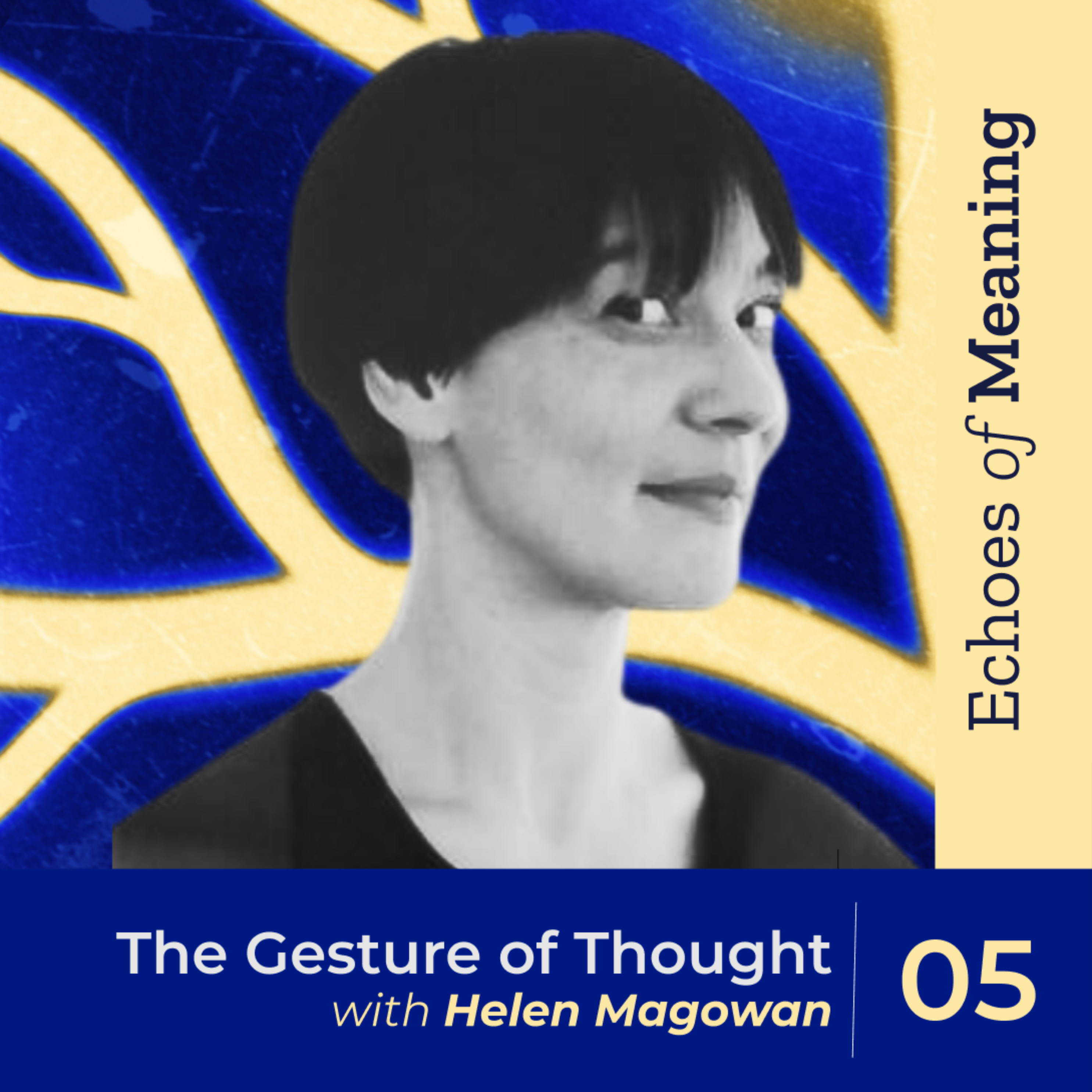
Today we are joined by Helen McGowan.
She is a researcher, writer and curator with a background in Japanese studies for the University of Edinburgh and SOAS.
And she earned her PhD at the University of Cambridge by researching pre modern women's writing in Japan.
Expression, presence, intimacy, identity, and memory are just five of the concepts we explored in this conversation.
Welcome to Echoes of Meaning.
[00:01:29] Speaker A: Okay, so my name is Helen McGowan and I just finished a PhD where I looked at 18th century Japanese women's calligraphy.
And the kind of calligraphy I looked at is called women's calligraphy. But it's not only written by women.
That's the first important thing. And then one really, really important thing that I found was that the brush strokes and the movement of the brush over the paper was really important part of how this kind of writing expressed itself.
So I had to think a lot about the interaction between the body and language and the body in writing and how we read bodies when we're talking to each other and when we're reading writing.
So when we think about the body in writing, in sort of, it's something we perhaps don't think about that much.
And there is a, a discredited science called graphology, pseudoscience called graphology, where there used to be an understanding that you could understand someone's personality from their handwriting.
And it's discredited because we can't actually say that, well, from this kind of handwriting, we can tell that the person is ambitious or, or has anger issues or we can't make those kinds of diagnoses, diagnoses about somebody from their handwriting, but we can see something about their body and their physical person.
So for example, if you look at your grandmother's handwriting, it might be a little bit wobbly. Older people have a slight wobble or uncertainty in their handwri writing that wasn't there when they were younger.
If you write a note, a Christmas card to your auntie, you're going to use nice handwriting. But if you're going to leave a note under somebody's windscreen wiper on their car to say, terrible parking.
Thanks so much. Then you.
Your handwriting is going to show something about that sort of mood that you are in when you're writing. I might write it in capital letters with double underlines and triple exclamation marks. And it's not going to be that nice handwriting of a Christmas card.
So I do think that writing can be expressive in the same way as the voice is expressive.
So when I say something like, yeah, sure, it sounds completely. Is a different meaning than if I go, yeah, sure, it's the same words, and we would type it the same on our phones or on our computers, but it has a completely different meaning that we as humans understand, but that isn't necessarily expressed by language as we write it down typically, or what we understand that writing does.
We. We have this sort of innate understanding that when a Christmas card comes through your door, you don't need to open the envelope to know who it's from.
You recognize somebody from their handwriting, and when you answer the phone and hear somebody's voice, you know who it is. They don't need to tell you who they are because you recognize their voice and the way they use their voice to say their words.
So it's that aspect of language and writing that I find really fascinating.
[00:05:39] Speaker B: Beautiful. And why do you say it is a pseudoscience?
[00:05:43] Speaker A: I think graphology is a pseudoscience because it's not really provable that, you know, ambition is associated with certain kinds of gestures or, you know, the, the way we divide up personality into sort of psychological traits is a. So it's, it's a science. Psychology is a science, but I think it doesn't align with what you can see from handwriting, that kind of psychological division of personality into the idealist or the somebody who is spontaneous or somebody who thinks through their actions. I don't think, you know, it's one way of thinking about ourselves as people and other people, but it doesn't capture everything. And handwriting, voice, none of these things capture anything. All of us, as I understand it, graphology is still used in court to say, to sort of bring some level of certainty to was this forged, Was this written by the person who has signed this document? That's legitimate.
But dividing ourselves into.
The idea that handwriting can show personality as a straightforward sort of connection, I don't think is really stands up to deep analysis.
[00:07:28] Speaker B: Yeah, I think that is like trying to prove and to get a record of all observations, you know, and this scientific exercise of trial and error and experiments and whatnot and determining certain truths. Or theories where these.
All this knowledge and this experimentation was based on and this production of knowledge.
But I mean, it. It called my attention. The fact that you said it was a pseudoscience because of course, is like trying to establish. And I always have a problem with that word put into boxes.
[00:08:21] Speaker A: Yes.
[00:08:22] Speaker B: Bunch of these tiny pieces was in. In something as fluid and as evolving and. And changing and. And everything as writing. Right. As body language, as we were talking the other day.
[00:08:39] Speaker A: Yes. Yeah. So in the same way as you can't. You can recognize somebody from the way they move and the way they run.
Let's say a footballer. You're watching a footballer play football. If you're familiar with that team, you don't need to see the number on the back of the shirt to know who that person is, because they run and kick the ball in a certain way and you can recognize that. But that doesn't tell us about that person's personality. It just tells us about how they move their body and how they play football.
But that's really important information for the other players on the pitch and for us when we're watching.
There's a lot of information that we get from that, but we can't exactly specify what kind of information it is. But we recognize that person, we know them. We can see that they look confident in that moment as they're kicking the penalty kick, or you know, that they're not running as fast as they usually do. Maybe they're not. Well, we have certain kinds of reactions that are in our bodies in a way. It's not easy to verbalize them or to turn them into language, but we understand each other's bodies on some very human level.
[00:09:51] Speaker B: You say that this all body language is also expressed in calligraphy, and your focus is Japanese calligraphy.
How did you get there? And I don't know what took you to understand it that way.
[00:10:43] Speaker A: Or handling objects in the real world.
So I started learning how to read pre modern Japanese writing because around 1900, Japanese writing changed quite a lot from brush written to using a pen and from the way they wrote before.
Different letter forms, different ways of writing.
So modern Japanese people cannot read pre1900ish writing without a bit of training.
So I started doing that training because I was interested in 18th century Japanese art.
And this art always has, not always, but there's very often writing on it.
And I thought to myself, I can't read. I can't read these pictures without being able to read the writing.
So I went to study paleography to Learn how to read this stuff. And during that summer school, the educator, the professor, put on the screen an example of some calligraphy that was really, really difficult.
And she challenged us to read it.
And it was a fun challenge, but. And my big question was, why would you do that? Why would you write in this way that is so difficult for us to read and probably very difficult to write? What does it do? Why would you do that at all?
So that became my PhD research project.
Why write like this? What does it do when you choose to write like this and not like in some other kind of handwriting?
Why are you making that choice? How does the reader understand that?
And then when I.
I really recognized the body, the involvement in the body.
When I was in Japan on field work, a really kind professor in Japan showed me a whole bunch of things that they had in their archives.
And one of them was a scroll of the calligraphy of 17th century courtesans.
And each woman had written a poem or a little letter or something on her own sheet of paper.
And these had been glued together into a long scroll, maybe 2 meters long, 3 meters perhaps.
And so when you're with a scroll, you have to unroll it with your left hand and roll it up in your right hand. And these different pieces of paper are passing across in front of me. Each one is a different color with different decoration. There's a blue one followed by an orangey red one, followed by a grayish one.
And so they're all beautiful. And everybody has a very different handwriting.
And in that moment, the paleography. Reading this stuff is still really difficult. I've spent, you know, the past four years reading it, but I can't instantly read it. But what I realized as these papers are passing in front of me was that I was seeing something about these women in the same way as I would watch dancers on the stage.
The past few years, I've become really interested in ballet, contemporary dance, different kinds of movements, the way the body can express itself on stage.
And this is exactly how I was reading these women's bodies. I can't read the language. And the same in abstract dance.
They're not saying anything that I can verbalize, but their bodies are expressing something that I read from the motion of their body.
And that's what I was seeing in these pages in this long line. It was as if one woman was moving onto the stage and then off of the stage. And a different woman, who was trained within the same discipline, has learned all of the same things, but moves herself differently, writes differently, and then the next one and then the next one. And it was this really magical moment for me that I realized that I wasn't using my language skills to read. I was using my experience of bodies, my own body and other people's bodies on a stage. That's the skill I was using when I was reading this script.
And that's when I realized that this is.
I've been bringing the wrong skills to. Well, not the wrong skills. All of the research I'd done up to at that point was fantastic. And really, you know, opened up these kinds of scrolls for me. But at that moment I saw it, I saw them.
It was magical. It was magical.
[00:16:04] Speaker B: You had like an aesthetic experience looking at this calligraphy of, of an ancient sanctuary.
And you realize that, I mean, that realization to me says a lot because you could connect with their language and you could see their art without not actually, quote unquote, knowing what you were actually looking at. But you understood it better than the vast majority of humans nowadays.
[00:16:43] Speaker A: Well, one, one thing that really motivates me still is that I believe that that is available for all of us, but we just need to come to it with the right eyes.
And once I saw that in that scroll, I started seeing it everywhere.
That all writing comes from the body and wherever you look, you can see it.
Where we don't see it is when something is typewritten or machine produced.
But if you look at, I live in Cambridge and it's one of the few places where there are still a lot of sign writers and we get a lot of hand painted signage.
So, you know, Professor Such and such's office will have a hand painted sign above it. So I'm fortunate to live somewhere where I can see handwriting a lot in a lot of places.
But when it's typewritten and signs now will be printed and they'll come out of the machine and someone will have designed it on a, on a computer, which is great, and you can do amazing things like that. But it hasn't come from the hand. So it doesn't have that particular expression that I have become incredibly interested in.
So even when you think about graffiti, somebody has climbed over a wall onto a train line and is using a spray can in a gesture that's so much bigger than the kind of writing I do with my pencil on a scrap of paper at my desk.
And so you can, you connect, you can connect that movement of the spray can to that person. And that's part of my experience of looking at it and reading it. I think there's a Lot of that. There's so many opportunities for that, but we just don't know to look for it.
[00:18:47] Speaker B: Yes. You are finding depth in this. In this, let's say, maybe small.
I mean, in, in the physical dimension.
[00:19:00] Speaker A: Yeah.
[00:19:01] Speaker B: In a small expression or, or. Or written expression.
And when you say that, you. Then you couldn't stop looking at it. I mean, it blew your mind. Right? This, this role definitely blew your mind and changed your perception of handwriting forever.
[00:19:23] Speaker A: Yes.
[00:19:24] Speaker B: So beautiful. So beautiful. And then you started just studying it so you could understand it.
Yes, in a more, I. I don't know, structured way. I don't know. So you can.
[00:19:36] Speaker A: Yes, yeah. To be able to.
So my research in writing the PhD thesis, I'm kind of hoping that people will read that and bring that to their own text, you know, because I looked at only one kind of handwriting, one kind of calligraphy style, but there are hundreds of different kinds of calligraphy styles, and they.
I don't. I'm not.
I'm not even an expert on Japanese calligraphy, all of it. I'm just this one style of calligraphy that I know intimately. But I do know that the style of calligraphy that I looked at shows me that calligraphy, Japanese calligraphy, makes a whole bunch of stuff available to us if we're looking for it.
And so the research is about inviting other people to look at their own texts with those kind of eyes. What might it be saying that I haven't looked for previously?
But there's also, you know, my PhD research is within Japanese studies, and it's going to be people who work in Japanese studies who might read it if they're suckers of punishment because it's 80,000 words.
But my PhD research was about Japanese writing, but I'm interested in all kinds of writing and how we can read and understand writing and hopefully how we can understand ourselves and each other better through that.
So, yeah, there's a lot more that I want to do if I get the opportunity.
[00:21:38] Speaker B: You also said that most people in Japan cannot understand this calligraphy unless they have a training in reading it.
Of course, all languages changes through time.
Right?
That's the normal thing to happen.
But how do you think it changed, like Japanese from.
I am not asking about particular details.
But what do you think that shifted in the cultural mindset that might distance Japanese culture, youth from. From these kinds of expression? Can you say?
[00:22:26] Speaker A: Yeah, it's a very interesting question.
I think so. The main change, from my point of view, between Japanese writing before and after, I'm saying 1900. But, you know, there's the big changes that are happening sort of late in the 19th century, early in the 20th century.
And one of the main things is that Japan started using typography, movable type to print.
And East Asia had movable type for centuries, but wasn't that into it.
So when Gutenberg developed his printing press in the 1400s in Europe, he was using technologies that had already been established elsewhere. And it made a huge splash in Europe and changed everything.
But it didn't have that impact in Japan or East Asia until the west arrived.
Commercial mass production at industrial levels could be done better with movable type.
And it looked more serious to Western culture.
Before that, writing in East Asia was with a brush, and it could be very connected and very flexible. You could do all sorts of things with brush that you couldn't do with typographic printing. In typography, every single element is separate.
In Japanese writing before that, every element could be separate, but it wasn't necessarily.
And I think there are other kinds of changes and reforms going on. But that separation of letters, each letter being separated from the next, I think changes how one writes. This is not something I've researched in depth. I don't know very much about this period, so I'm more drawing a contrast between the past and the present.
Look, in Japanese now, people don't really tend to write joined up and they don't write with a brush and things. Letterforms on a page look more like shapes than movements, and the movement is still there.
Not making much sense here.
There is still. Movement is important in Japanese. Chinese writing, you always have to have the stroke order correct. And when we, as foreigners start learning Chinese or Japanese, we don't care about stroke order. We just see a shape on the page, but the stroke order is fixed and it has to be done in the correct way, otherwise it doesn't look right.
So there is an underlying understanding of movement in writing Japanese, but you have this very distinct separation and use of spaces and punctuation of commas that wasn't there before.
But I think.
I think for me, that the big difference between pre modern Japanese writing and modern Japanese writing is the expressivity of a moving brush, which a pen or a pencil doesn't have.
A brush is really, really sensitive to what your body does.
The Japanese, the East Asian calligraphy brush is very, very, very, very soft.
And to control it, you need to have really good control of your body. You have to have really good posture, you have to have really good steady breath.
You have to control your Arm, your core, your spine, your hand.
Whereas when you write with a pen, I'm just picking up a pencil right now on my desk, and I can write words without moving my hand.
It's only my fingers that are moving.
And so I think there's perhaps some kind of a increased separation between the body and writing when you change the instrument and writing.
So that when your whole body and posture is involved with a really flexible writing instrument, it expresses your body much more clearly. It requires a lot more discipline of the body to be able to write well and beautifully.
But it also expresses your body much more clearly for your reader.
And I think that's something that we have less when we use pens and pens and pencils. And it's irrelevant when we're typing on a phone or on a keyboard.
And I think that we in the 21st century are quite disconnected from our bodies.
And we understand ourselves somehow as brains carried around by meat sacks.
When our body is the medium of our entire experience.
And we kind of disavow our bodies. You know, none of us have a.
Who among us has a positive body image? Probably nobody.
And, you know, we kind of want to discipline our bodies.
I should do more exercise. I should lose weight. I should be stronger. I should put on weight. I should develop my posture better.
And so our bodies are kind of a problem for us when without our bodies, we're not alive. We have no way of being in the world without our body. It accompanies us constantly through our life.
It's always there for us. It's always breathing for us.
And so that disavowal of the body is really sort of. For me, that's the thing that I'm very interested in that I think that's a contrast that comes out from when I'm looking at Japanese calligraphy in the 18th century. And any kind of writing now is this disavowal of the body.
[00:29:48] Speaker B: Everything you're saying to me is so interesting, like, very, very, very. Because you started looking at writing as a dance, and then you found this connection in between this complex calligraphy as a body expression that at the same time is a language expression.
And now you are observing how it changed.
And the fact that we are so disconnected from our bodies doesn't allow us to understand those writings.
[00:30:30] Speaker A: Yes.
[00:30:31] Speaker B: From the past, because that's all on the culture. That because of how we write, we can see our relationships with our bodies and everything, basically. Because the relationship that we have with our bodies is not only the relationship we have with our bodies, but with everything yes, yes, yes.
[00:30:59] Speaker A: I love the way you summed that up.
Yeah.
I mean, in, in academic research, we're kind of talking about, like, how this research is relevant to the wide world. And I'm like, it's made. Doing the research has made me realize that it says something about the wider world and how we are in the world.
And I. Yeah, I kind of love that.
[00:31:24] Speaker B: Beautiful. Yes. I think that's, that, that's, that's the most curious and entertaining, I have to say, and creative and fun way to look at research. Because I think it's very common that we look at research as a way to register what's going on out there.
But. And maybe to even, let's say, quote, unquote, understanding, because we don't actually need to understand and we don't actually need to register everything, but we want to.
And what I want to register, and the thing I want to elaborate on is this thing. And I'm very likely going to find out something that I am not supposed to or that I am not looking for.
And here we are talking about how calligraphy tells you about the relationship that Asian, Japanese.
I understand that not only women, we're going to talk about that. Used to register the reality based on what they knew.
[00:32:34] Speaker A: Yes.
[00:32:34] Speaker B: And what we can learn about us from that observation.
[00:32:38] Speaker A: Yes, yes, yes, exactly. Perfect.
[00:32:42] Speaker B: And how is this calligraphy style?
Because you said that. Yeah. You are only. You're an investigator on this particular style that is called.
[00:32:56] Speaker A: It's called.
Which means.
Is a word for woman and hitsu means brush. So it's a style of calligraphy that's called the woman's brush.
But it's not only used by women.
And to understand why it's called the women's brush, you have to understand the wider Japanese culture, which works on.
Academically, you'd call it a dialectic, but you have.
When we're talking about masculine or feminine, we're not necessarily talking about the biology or the physical expression.
You have all of these opposites, so you have masculinity and femininity. You have that which is Chinese and that which is Japanese. You have that which, which is public and that which is private, that which is external and that which is intimate.
And so all of these opposites align into a greater whole.
The kind of writing that I was looking at aligns with the feminine, the intimate, the personal, the expressive, and other kinds of writing that might be Chinese and impersonal and official documents written would be written in that other kind of style.
And of course, there's A whole spectrum in between. And you can sort of pull in and out different aspects depending on what you want to write about and how you want to write.
So my kind of writing was used for personal letters, intimate letters and letters talking about the emotions.
And it's also the same, very similar to the kind of writing used by people writing poetry. Traditional Japanese poetry has this emotional quality. And what it looks like is it's very connected and joined up.
So the opposite kind, the masculine coded, external, public Chinese style writing, is much more separated and it uses a lot of Chinese characters, which are called kanji in Japanese.
My kind of writing uses far fewer kanji and a lot more syllabic hiragana.
So it immediately looks very different.
It's also much more cursive and it has lots of connection and it's very, very extended on the page, very vertical. It's not compressed like kanji. Kanji, kanji, kanji, kanji. It takes its time, it spreads over the page and it has these really long connections.
What that means is that you can't hide your body, you can't hide your embodiment when you're writing to somebody.
If I'm writing, let's say I'm writing in English and I'm writing in capital letters, each time I finish a capital letter, I can take a breath, have a look at where I'm going to put the next letter, make it match, make it all line up.
And when I'm writing in joined up writing, I don't take that moment.
It's all continued, it's all continuous motion.
My kind of writing in Japanese, because it's all connected and really cursive, it expresses the body. You can't hide your body, you can't fake it.
So that means that these letters point towards sincerity and openness and intimacy.
When in a way that, in an embodied way, the writer isn't.
The implication is that the writer isn't hiding their inner self, they're showing their inner self.
And the context for that.
Sorry if I'm going on too long, but the context for that is, in Japan, looking at someone meeting somebody in person has a kind of.
Before the modern period, looking at someone was potentially degrading to that person. So if you're a really important person, people aren't allowed to look at you.
If I'm, let's say I'm a great daimyo warrior, the head of my clan, and I'm parading into the capital city, all of the plebs and commoners walking around, they're Supposed to get down on, onto their knees and look at the ground, bow down and look at the ground.
Their homes and castles and houses, they don't have the kind of open gates and structures that we have in the west.
So take Buckingham Palace. It has these huge gates at the front and we see right through the gates to see the building.
A Japanese palace just has walls. You can't, you can't look through it. Even a.
Any kind of residence that belongs to anybody who was important has no windows, no gates that you can see through. It's completely private.
And so to actually look at somebody in person is a very intimate gesture that's only allowed between people who have a kind of equal social status or close enough social status, have a close enough, in some cases a close enough relationship to be able to meet that person.
And particularly for women, the women's quarters of a large daimyo's residence, say, is in the back. It's far away from the public, it's in a very private space.
And so writing letters between people is a way of.
Becomes a way of meeting each other.
And so you only going to meet each other if your social status and relationship allows that.
So the expressiveness of this kind of writing is really analogous to meeting somebody in person that, that the intimacy of expression isn't given to just anybody.
Which is why we also see it used in love letters and we also see it used by courtesans who are professional love letter writers.
So the big deal about a courtesan is not having sex with her.
It's. She is, she's highly educated. She's more of a princess. You know, she's. She's got these beautiful clothes, she's so elegant, she knows how to move, she can dance, she knows poetry.
Just having drinks with this woman is a huge access to her, to women of that kind of quality, princess like figure.
So it's not about sex, but when she writes you a letter to say, oh my God, last night was amazing, she's constructing an intimate relationship by writing in that manner. In n.
She's. She's saying to the client who's just, you know, gone home, she's saying, that was wonderful. And I feel intimate with you because of having had that experience with you, having shared that space.
And this is what I think about it. And I had this and it'll be all full of like, it's an act of sincerity. But it's more complicated than that because it's a client. So, so she's performing sincerity for him. But she's performing. I've never quite felt like anybody else the way I felt about you last night. I really wish that we could have spent more time together because there are so many things I wish I could have said, but I wasn't able to say them. And my only hope is that you come back really soon so that we can talk more.
And she's using this handwriting that talks about intimacy, about the way they spent this time together.
And she'll often finish with something like, my brush cannot describe my feelings. And the only thing is for you to come back and talk to me again. And I'll not be happy until that happens. And I beg of you to please grace me with your presence so that I can experience that again. This kind of very. It's very florid and intense, but it's also this idea of intimacy that is happening on the paper that reflects the intimacy that they've already had.
So it's a very powerful way of writing.
And any. The reason I saw the scroll in Japan is because when somebody received a letter like this, it was really valuable to them. They're like, oh, my God, she is so into me. Look how into me she is. And they're, like, comparing them with their mates this morning.
Yeah, yeah. And it's. It's becomes this whole big game.
But, you know, the. The intimacy of the brush is something that people treasured and they kept these letters, and that's why 300 years later, there are still scrolls in various museums around the world where you can. You can see these women's handwriting.
A scroll in itself is the highest, most premium form of collecting these things. You can. You could have an album that's structured like a book and you can open it, but the intimacy and the specialness is reflected in the scroll form. And there are some in the.
In the Met Museum in New York, and you can look them up online, and they're wonderful. And. And it takes many, many digital photos to show these.
The ones I saw are in Tokyo. But there are. You know, these things have been collected and are still treasured because they were so. They were incredibly special at the time. And that's remained the case.
So I would recommend to listeners to go and have a look at the digitized ones at the Met Museum.
[00:44:48] Speaker B: Amazing.
This whole context that you give with the social status and how they were not allowed to look at each other, basically, it gives a lot of.
Of course, it. It helps you a little bit to dimension the.
The power of. Of. Of presence.
That's what I.
[00:45:17] Speaker A: Yes, yes. Presence. It's about presence.
And, you know, I think to take it back to US in the 21st century, it's something that we often don't get enough of anymore. Especially post Covid, we, you know, zoom and video calls are amazing. We would not be able to have this conversation. We would never have met if it hadn't been for what you can do with video calls. So I absolutely don't want to diss that. But we also, we find other people annoying. If you live in a city and you're sharing a bus with like a bunch of people and some of them are too noisy, you know, we're uncomfortable with presence in some ways, but I think in Covid, we also recognized how valuable that was and that zoom calls aren't a substitute for actually hanging out with people in person.
And that that sense of presence, I think is really, really precious and valuable.
But we find more and more ways to, you know, for me to go and visit my friend, it's a two hour trip, or for you to go visit your friend is a two hour trip. It's a really, really long way. It might be more efficient to just have a zoom call or a phone call, but what you get from that visit can't be, you know, efficiency is not the right way to think about it because you can't hug your friend, you can't vibe with in the same way, you know, that, that presence is really, really special and miraculous.
And I think back even to when I was an undergraduate was before email and smartphones and my friends and I used to write to each other letters. And I look back on that now and I've, you know, I'm not writing letters to people, but I do miss those times, you know, that what the kind of communication that you used to get from a letter, we don't really have anymore. And it's a, it's a shame in many ways. Having said that, I'm not, you know, I, I keep thinking I should write that person a letter. I never get around to it because it sucks up my time and I'm supposed to be doing other things.
Know, there are these things that are really valuable that we don't do.
Yeah, I, but that presence, I think is a really, really good word for the thing that I was looking at in your interview.
[00:48:05] Speaker B: Yeah, you were, you were looking at the evidence of what presence meant for Japanese in the 18th century.
[00:48:15] Speaker A: Yes.
[00:48:16] Speaker B: Jesus Christ.
And you could, and you could like interpret it and you saw the dance and the movement and then you started and of course it was Like a revelation to you.
It was a revelation, and it was a revelation you could like, relate to, although all that experience and everything, you know, and you just understood it. And then you're like, okay, how do I explain this?
[00:48:48] Speaker A: Exactly, exactly. I've seen something. How do I put it into words and explain this thing that I saw.
[00:48:56] Speaker B: This experience I just had? How can I explain this to someone else?
[00:49:01] Speaker A: Yes, exactly, exactly.
But I'll tell you what, it's much easier to do in speech to you right now than it was to write it in a PhD thesis.
That was much, I think, you know, with. When you're talking to somebody, you are sharing presence, even though this is digital presence. But we.
I can share with you that experience in a way that is very, very difficult to do in writing, ironically, because it was an experience of reading writing.
But to write it for you to read, it kind of loses that. So you have this, I don't know, perhaps presence can only really be shared and expressed through presence. I don't know.
[00:49:46] Speaker B: Yes. You know, I think that these kinds of knowledge.
[00:49:51] Speaker A: Yes.
[00:49:51] Speaker B: I mean, we need to register this experience somehow. So people in other parts of the globe and, and different in different moments in history can't get a glimpse on what that moment was like for you. And you had to write it down, like maybe dates and your motive and your vision and everything that you can like, type into a academic article. Yes, yeah, that. That factual data is important.
[00:50:28] Speaker A: Yes.
[00:50:30] Speaker B: And the difference that you're mentioning between it's trying to explain this in an academic article and then doing it in a conversation.
I think that's why people write literature.
[00:50:44] Speaker A: Yeah.
[00:50:45] Speaker B: You know, like trying to express this highly complex idea that you cannot just explaining with data. You have to relate all that knowledge through this world that you build and then you just send it out to someone else. I have this friend. He. He's working in the Netflix series of. Of 100 Years of Solitude. Oh, yeah?
[00:51:09] Speaker A: Yeah.
[00:51:10] Speaker B: And he, he is a, A big Gabriel Garcia Marquez fund. Fund. And when he got to work in this multinational multi millionaire work of, Of. Of this, where a lot of interest, interests are in play because you want to sell and you know, this huge audience as whole, the whole Latin America, you know, And he, he always speaks about a truth that Gao was trying to communicate through this very complex work. You know, this is like the Latin American bible, something like that. Like you are trying to communicate a certain way of looking at realities through this novel, which is like.
And, and. And that's what art is. Right. Like, we are here Talking about human expression.
[00:52:19] Speaker A: Basically.
[00:52:20] Speaker B: Basically. And this tool that you, that you describe, this very sensitive brush and the posture you needed to have and it's, it's very like. It is a. Definitely a vehicle.
[00:52:34] Speaker A: Yes.
[00:52:34] Speaker B: And you, and you cannot lie. You cannot lie when you are, you know, and communicating through this very transparent vehicle is everything, you know, it is because you are the, the expert here.
[00:52:55] Speaker A: I mean, I think one thing about academic writing, it reminds me what I said earlier that in Japan there was this kind of one mode of writing that was very public and external and another mode of writing that was personal and expressive. And I think academic writing leans to the public and external and we necessarily take our emotions out of it. So my emotional reaction to that scroll and how it's made me feel about the world differently. It's not something that's, it's not my thesis. It's not.
My thesis is not the place for that kind of thing because that's for other scholars to hopefully read and use that to inform their own research.
But the way it changed me as a person is incredibly important.
But the space for that is not the PhD thesis. And so it's actually really lovely to be able to talk about that with you because how I don't have an opportunity really to sort of tell people, you know, I saw this thing and it was amazing, it was magical and it's changed everything. I see everything different being helped.
And it's a shame in a way because that was for me as much part of my research as all of the things that went into my thesis.
[00:54:35] Speaker B: I agree. I, I fully agree. And I think there is a place for, for the emotion and the vision and the philosophy of a person that is having this very in depth experience on any subject. Any subject. Because the PhD is definitely a lot of focus on, on. On one thing that it can be as wide and as specific as, as the investigator is. Is intended to see.
And I think there is room for that. You know, I think we, we have spoken about the, our take on, on, on this kind of writing, but the same way we have relegated.
Relegated, neglected. I'm sorry, the same way we have. Okay, both. Okay, you, you can use both.
Relegated. Then the, the in talking about polarities, right? You just defined feminine as private, as connection, as expression, as honesty, as transparency with yourself.
You know, like your truth.
And we can define this, this, this, these polarities in different ways. No, this is just one way of talking about this. And I mean just to be clear, because there's a lot of politics in this topic. So, yes, so yes, just talking about this internal aspect, aspects, this connection with your body, with your mind, with your emotions, we have definitely relegated that. Yeah. And that's why the body becomes an obstacle and not a. And, and, and. And now this carrier of truth. Of your truth. Yeah, that same way. I think we are relegating this same aspect in. In.
In writing knowledge and in writing the experience of getting knowledge, because knowledge is something that you gain through experience and you can register everything like I did this and did this happen, and I think this because of this. But how are you feeling about it? You know, I think if we start to registering these feelings and the fact that you and I am glad you found this space to talk about that. And that is in part the reason I am doing this podcast is so remarkable. People and definitely talk about. About their experience, you know, not only the facts. And so I. We bring here interpreters, linguists, researchers to. Okay, but what is it that you see and how do you see it and how do you feel it? Because I mean, this all can go into a paper, academic paper, I'm positive. But we are not there yet. I believe.
[00:57:56] Speaker A: Yeah. Yes.
[00:57:57] Speaker B: Yeah, we are going to. I believe in this. I. I believe. I believe. I believe.
[00:58:03] Speaker A: I believe too. I believe.
I think, you know, I work in humanities. My. I'm arts and humanities, as opposed to stem.
And STEM has, Is.
Has a kind of.
I feel like STEM has a kind of respect and certainly money that the arts and humanities don't have socially. It's STEM is measurable and it has understandable outcomes, like, you know, curing cancer or solving the problem of microplastics. These kinds of things are really important.
But the. In the humanities, we're looking at the human experience, trying to understand perhaps what it means to be human.
And I guess you have to ask questions about how you share that and what I, you know, this is why I think the arts and humanities are incredibly important.
And, you know, when I work on 18th century Japanese women's calligraphy, what I'm really doing is exploring what it means to be human, because these. This kind of writing is showing me something that I don't learn from my own environment.
And it expands how I think about myself as a human, but also the capacities of humans to connect with each other and be human.
And the.
These. These are things that I don't want to keep to myself. I want us all to benefit from that. And so, you know, I think there's an argument for different ways of communicating academic research.
All of these things came out of my academic research. But they are things that have changed me as a person and potentially could open up new ways of thinking about ourselves.
And I would like to find other ways of talking about them for certain, you know, for sure.
[01:00:33] Speaker B: I think this is a great point in our conversation and I think we reached to very important, sensitive, honest, beautiful places and ways to look at things.
And thank you for, for wanting to have this chat with me on this beautiful show. Thank you again, Helen, for, for sharing all your knowledge and or not all your knowledge, part of your knowledge that comes to this conversation and, and I hope to, to have you again sometime. We can, we can chat about whatever it is.
[01:01:18] Speaker A: Yeah.
[01:01:19] Speaker B: That we want to chat about because this is a podcast about language and language we are using right now. So about whatever it is that we want to talk.
[01:01:30] Speaker A: Yeah. That's the amazing thing about language, right. Is that we can use it to talk about anything.
[01:01:43] Speaker B: Thank you for listening to Echoes of Meaning. My name is Camille. My name is Kila Sabugal. I'm a media producer at Multilingual Media and if today's conversation stayed with you, I would really appreciate if you left a comment or rated the podcast whenever you're listening. It helps more people find these stories and the meaning behind them.
See you next month. And let's remember to listen.
[01:02:13] Speaker A: Sa.