Episode Transcript
[00:00:07] Speaker A: Okay, so this podcast is about meaning, right? We can talk about it because we can name it, and we kind of know what it is. It is a concept. But we take for granted our wonderful capability to name stuff, to create concepts. And the reason we do that is. Is because concepts are always changing, and they are all subjectives. And that is super uncomfortable.
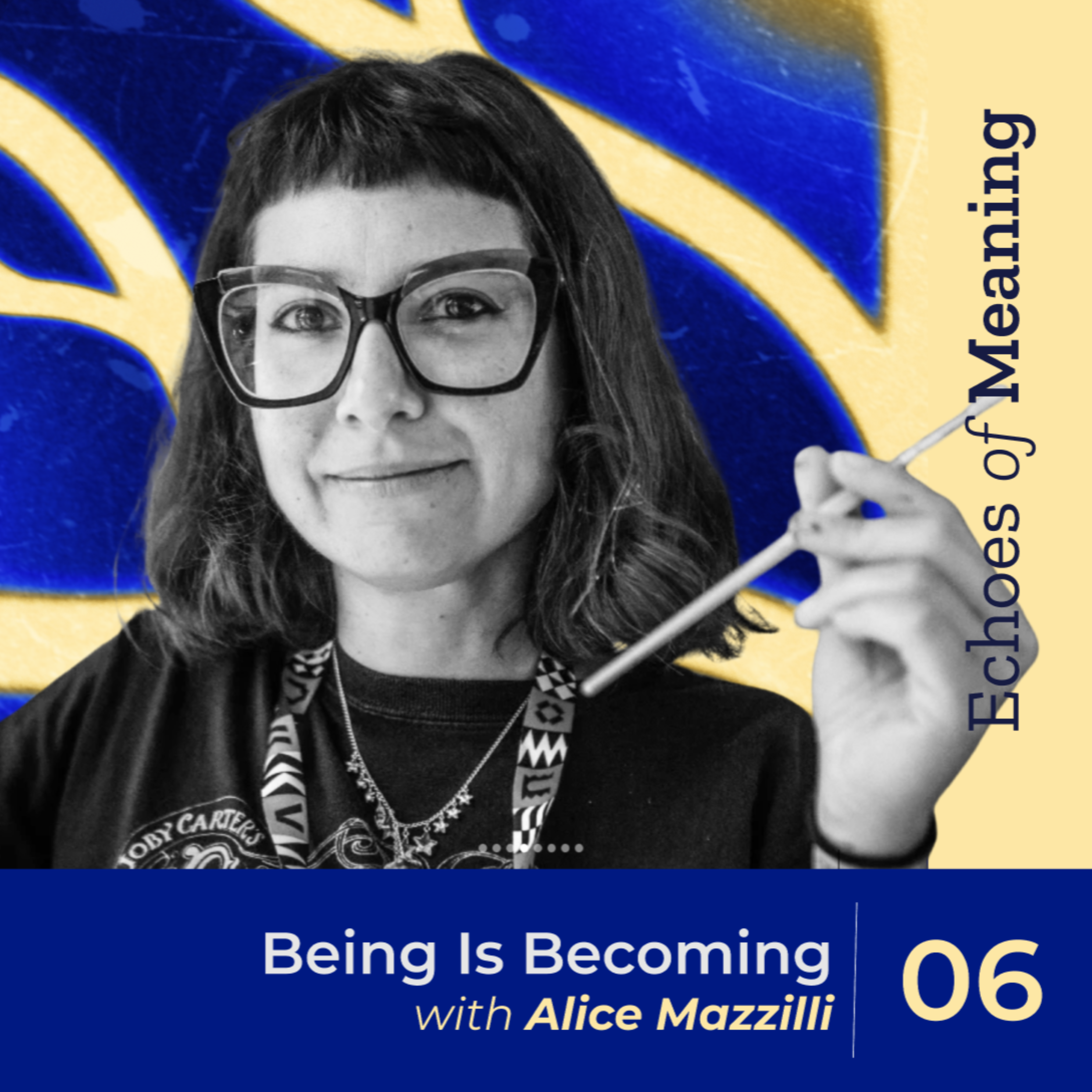
Now, the thing is that meaning is a concept, too, and somehow that's what we are talking about today with Alice Matili. She's an Italian writer and professional calligrapher whose craft goes from hand lettering for clients, writing on walls, style writing, not graffiti, and painting on canvas, treating writing as an art form beyond readability.
She also writes and speaks academically about writing, focusing on how meaning shifts across people, cultures, and contexts.
Welcome to Echoes of Meaning.
[00:01:24] Speaker B: Yes. Well, thanks for having me. It's a pleasure to be here and talk about what I do, which is. Is not too easy in a way, to describe because, like, what I'm working around, it's the connotation of words.
So, for example, what I would say, it's the. You know, my name is Alice Mazzilli, and I am.
That's the problem, because I would define myself as a writer, right?
Because I write.
I write as a job, so as a calligrapher.
So using the form, I write on walls, which it's defined by sustainability, society as graffiti, but not by the culture, the original culture. So it's. I will maybe get back to it later why it shouldn't be called graffiti. But for now, let's leave it this way.
And I also write academically about writing, so.
Yeah.
And I paint canvases also. So it's like an art form.
So all of these, it's under writing. Because I use words for what I'm doing that don't always entail meaning.
I mean, everything entails meaning, but not as the traditional way of writing that you have to read to understand the meaning. Like, it can be conveyed in different ways.
So that's the long introduction of what I do.
I. I am Italian, but I lived in London for a really long time, for 20 years, and I'm still working over there as a calligraphy, as a professional calligrapher.
And now I'm came back to. To Italy because I felt like I needed to get back to my roots and reconnect with that side of myself. Plus, obviously, the weather, the foods, the wine, you know, is all, like, really good.
[00:03:50] Speaker A: Ingredients. Yeah, definitely.
[00:03:52] Speaker B: Definitely everything nicer.
[00:03:54] Speaker A: But yeah, yeah, definitely. Like feeling the sun and being able to enjoy the sun.
Is a huge experience and it changes you. Like, it changes your humor, it changes your mood in a general way. Right.
[00:04:16] Speaker B: Yeah, I totally agree.
[00:04:18] Speaker A: Totally. Different experience and that's why you have different food and that is why you have wine and that's why you have these beautiful shores and you glad you. You go to. To be back and experience that different approach to everything.
And that's part of meaning. Definitely. Like now the meaning behind everything you do is different because you're in a different place that represents different things for you. Right?
[00:04:49] Speaker B: Yeah. Yeah. Also, it's a place I ran away from so. Because I just wanted to go as far as possible because I left when I was 18 and I kind of like wanted, you know, to go just away. New culture, different language, sea in between.
So within Europe was the farthest I could go.
And yeah, so it was a challenge for me also to. To come back and face those demons in a way of myself because it was. I was run away from part of myself also. Yeah.
[00:05:26] Speaker A: You said something about getting the meaning from reading is the. You can get that meaning in different forms. What did you mean by that? So we can start understanding the thing you do.
[00:05:40] Speaker B: Yeah, I.
With my experience in writing and life because like now I find very difficult to differentiate what I do from my way of living is I cannot be something that's different from what I do.
So all my research goes into inform my way of life, which is about relational.
So as meaning is not something set is something that is in constant movements.
It evolves, it changes, it transforms for every person, it's different. Like if I say the word, for example, home, it will be different for each one of us.
So it's not something that it's. We can consider as absolute and universal we, which is something that's been done with writing. Like, for example, writing history, male laws very much, especially the Western culture and the Western society is very much based on these fixed meanings that, okay, this is the law and that's just the way it is.
And I think this is a very colonialist way of seeing reality. And nowadays we.
We have to face this situation because nothing cannot be political right now. Even not caring about a subject, it's political because you make that decision.
So I am applying this also to writing because the way I'm living, every decision I make, it influence my work as an artist.
And I think it's really important to look at writing from this point of view that it's especially working with the Western Alphabet.
So it's a writing system that is alphabetical.
It's very limiting because you have a vision of writing which is based on the sound that corresponds to a symbol.
But that's the only writing system in the world that works like that.
Egyptian hieroglyphs or the Mesoamerican ax, like Maya, even the Chinese work in a different way.
So I find it, like, very racist to define things through this perspective.
And it's something that, for me, is really important to talk about, because with calligraphy, we give a lot of things for granted.
The history of writing starts from the Latin Alphabet, but it's not like that. There's so much more to it. And it was a way of defining a hierarchy of cultures. So. So the Latin Alphabet was imposed to, like, so many countries, like South America, for example. The whole America, not just South America, actually, because now we kind of like, see. Oh, no, there's always been like that in the north, but no, in Africa.
And he stripped the cultures of a huge part of their identity.
Because all the Mesoamerican manuscripts, the. The Aztec, the Maya, the Incas, were glyphs. So there were. It was a writing system based on these glyphs. So obviously they look to an alphabetical writer as pictures, but they convey meaning. And they had, like, a code and a system, but they were discarded as illustrations like that. There's not a writing system. And they started the hierarchy of, like, the. The Latin Alphabet being something, like, superior than the other ones. And that's something that. With what I do, I really want two points at, you know, and discard this way of thinking.
Yeah. So meaning, it can be generated not just from reading of the words, you know, it can be generated in many different ways and adapted to what you want to do and you want to say. So the way I'm using, like, the Latin Alphabet, because it's like, what I'm. I learned.
But what I'm trying to do is, like, not to write in a series of.
In a hierarchical way, basically. Yeah.
[00:10:55] Speaker A: Not in a conventional way, but you are, like, exploring and challenging this Alphabet, basically.
[00:11:01] Speaker B: Yeah. Yeah.
[00:11:04] Speaker A: That's beautiful. Because, I mean, when you have this huge questioning on what meaning is, and when you have this interpretation that meaning is constantly changing and moving, because we are constantly changing and moving, you definitely have a different, more elaborated perspective on what you can do with everything, basically. Right.
Because you can definitely challenge it and play with it.
[00:11:39] Speaker B: Exactly.
[00:11:40] Speaker A: And explore it.
[00:11:42] Speaker B: And it's really exciting when I start seeing like that, you know, for me, in the moment, I was like, I can do whatever I want, really. With the words. And it's so much fun as a calligrapher that the way I learned calligraphy. Right. In the UK and Europe.
Most of the workshops, they tell you bring a poem or you know, something you want to write.
So it's always like about the form, never about them, what you write, you know.
So for me, it's so important if. If I teach calligraphy, which doesn't happen very often, but it happens sometimes.
[00:12:26] Speaker A: To.
[00:12:27] Speaker B: Get the people to write their own words. Even if it's one word, even three, life, whatever, it doesn't matter. But it's a word that comes from you, like from this moment, this specific moment, this energy that you are creating.
Because the other thing that I've been reflecting a lot upon all.
It's the writing in a way. It's this pose between this energy that we have and matter.
You know, like thoughts. Thoughts like, tend to be energy, like something that is. We cannot touch.
[00:13:10] Speaker A: It's generated.
[00:13:11] Speaker B: Yeah. While writing is something that you see, like down, like you can see. So it becomes matter.
And also in physics, everything is based on that, you know, energy becoming matter. That's what we are also like the reason why we are alive. So why not seeing writing that way also like the way we generate writing. So more than a technology that we have, it's more like a way of being. Like our modes of being, which is natural, comes natural to us because we've been doing it forever. It's same as language.
It's not something that we created because like this idea of the human creating something and it's kind of like the I at the center of everything is not something I really agree on or live by.
[00:14:11] Speaker A: Yeah, I love that you mentioned physics because like I've been. I. I have been thinking about this a lot for. For the past couple of years about how we definitely.
Of course, we have said this before through history. We know this, that first thing we do is think about something and then it becomes reality, then it becomes matter.
Some way along the history.
You know, if I can think of flying in a machine, then someone eventually is going to do it. And yeah, there is. That's how the science fiction works, right? You are constantly creating these scenarios that can become true eventually.
And how physics interprets.
[00:15:08] Speaker B: See.
Yeah.
[00:15:10] Speaker A: Separates what's going on, you know, because science is this bunch of data that we gather from experimentation with matter. Right. And then what physics do or physics does is reading that bunch of data and it's like, okay, this happens this way because this is what's going on. You Know, actually it connects all the dots.
[00:15:40] Speaker B: Yeah, yeah, yeah. It's an interpretation that we have of our environment and the way we perceive things. Yeah, correct.
[00:15:50] Speaker A: I was, I was talking about this with a friend of mine yesterday, actually.
And. And of course, meaning and words is words, basically the way we conceive. Words are like an abstraction of the meaning, which is the constant.
Like you defined it. And I believe it's important that we go there later.
Constantly changing concept that we, like, is cracked so we can talk about it.
[00:16:29] Speaker B: Yeah, exactly. Yeah. It's just a way for us to.
To use language, really. Like, that's, that's why we, we have language. It's like a part of being human, I think.
[00:16:45] Speaker A: Yeah. Is the, is the expression like the way we express ourselves, the symbols we use to express ourselves are tied to what we are, no.
[00:16:58] Speaker B: Yeah, yeah, yeah.
That's what makes us different from other things in the world. Like also the mushrooms, they have like, an amazing way of exchanging things that we don't know because we, we know mushrooms.
It's just like we can never know how they.
Or what they feel, you know, it's just like, very patronizing of us, like, being like, oh, they communicate this way. There's a way of, like. No, we don't know, like, even like plants and trees and everything, Stars. Like, we don't know because we, we know them as. They don't know how we work. We don't know how they work.
And that's something we have to accept.
[00:17:48] Speaker A: Definitely. And it's all about, like, the perception of reality. Like, to us, reality is this way, but to other organisms is a way we cannot even imagine. And I agree it's very patronizing to know. Of course, a cat, they don't see in colors because they have this kind of brain. And you have no idea what. How a cat perceives reality because they have these hairs and they can see.
We don't know how they interact with.
[00:18:15] Speaker B: How they feel also, you know?
Yeah, it just.
Yeah.
Something that is really, I think, important to keep into account, like, in everything we do. Like, I was reading something recently that about how the brain creates pus with languages that we learn. So for example, if you are a German speaker, they did a test, like a scan of the brain, and the language site affects certain parts. Like it creates a sort of map which is very different from an Arabic speaker because the Arabic language works in a different way.
So you create a different map in your brain. So going back to what I was saying before, this way of imposing one culture over another and diminishing the other just because of your structure, I think is something that is a huge problem right now.
I think it's what like causing most of the problems right now, but it's not really talked about.
Yeah, yeah.
[00:19:40] Speaker A: That is the thing with diversity. Right. Like acknowledging actually like the infinite ways. And we cannot understand how different they can be from one human being to another.
Starting from the intimacy of people like we don't know. Right.
What do you think? Why do you think that we have adopted in Western this way to write like writing with the Latin Alphabet? Why do you think that writing representation of the human experience is what we have today, the way we have it? I am not asking about colonization or who is.
[00:20:31] Speaker B: Yeah, no, it's something I asked myself also. So I can give you what I think and what I researched. So you happen with Phoenicians, because life phonetic Alphabet comes from the Phoenicians that there were merchants going all over the Mediterranean.
So they encountered the Egyptian culture and they saw them using a certain writing system.
And from there they extrapolated from the Demotic. There is a coscursive form of the hieroglyphs, you know, this use of symbols. And they developed something that's very practical.
And this practical form was like translating sounds which already that the Egyptian had. Like Egyptian writing was half.
It had some.
Some thing of being phonetic, but it was mainly glyphs and syllabs, syllabic.
While they took a sound as one symbol.
And then was taken also by all the Greeks.
And those systems there were like different ones that I won't go too much. I could talk for hours about this, about all the history about. I'm gonna go straight to my mind Greeks.
So the Greeks saw dialectic, so spoken word as something superior to writing.
So while in Egyptian culture, for example, the scribe and writing was something that was like a manifestation of energy, you know, a way of connecting the sky and earth, like, you know, the divine and humanity.
So I had like these magic around in a way, you know, manifestation, like different vision. So just certain people could.
Could do it. Like it was an. Actually an honor to. To do it.
Well, from the Greek writing was done well the slaves had to do it basically because the. The main thing was like the ideas, the dialectics, all the philosophy. The Greek philosophy is based on, you know, ideas and that's the basic of everything.
And writing became just something that you gonna take notes of my ideas. So spoken words is superior to written words.
And from there the Latin Alphabet develops. So the Romans also took this Idea of writing and calligraphy also developed because it's something they just. About the form, not really about. Because that is someone else, you know, doing the thinking, whoever is rising is just doing a service kind of thing.
Yeah. And that's what I do also as a calligrapher is a service in the end for, for clients. So it comes from that.
[00:23:55] Speaker A: Okay. Do you think that, that, I mean, and this is what I'm getting. The practicality of this system is what makes it so relevant today.
[00:24:08] Speaker B: And yeah, yeah, it's just very practical. Yeah.
Because it's a sample.
Even like all the technology and coding and all of that is just very practical.
Yeah.
[00:24:23] Speaker A: And this is what we have based on the development, the scientific, the everything kind of development.
Tell me a little bit about meaning also. Always changing.
And maybe because we have spoken about your definition of meaning, which I believe is essential and because I also want to understand the things thing that you do because you said it was very hard to explain. And I think this episode is going to be about us understanding and you being able to explain the thing that, that you do.
So let's go back to that definition of your craft and you connected it with your life. And I believe that is super accurate. I believe that language is the art that we make all the time, you know.
But tell me a little bit about meaning always changing and that definition of meaning, is it always changing too for you? What do you. How, how do you feel about that?
[00:25:34] Speaker B: Oh yeah, for me, everything is always changing and which is quite difficult when I started, you know, writing academically or to going to conferences. So every time I actually just finished writing the talk for a conference next week.
And I know already that in maybe like two, three weeks, as soon as I, you know, talk to some people or read something else, I'm going to change, you know, and be like, ah, what I said it just like it's not accurate enough.
I have to add more layers to that.
So it is so complicated when something is written to stick with it. For me, that's the problem I'm finding.
Imagine my website, I haven't updated it in ages because I'm like, okay, let's.
[00:26:31] Speaker A: What is the point?
[00:26:34] Speaker B: Let's leave it either way.
[00:26:35] Speaker A: I should just have to update it tomorrow again.
[00:26:42] Speaker B: But you know, it's okay because like I also have to. It's teaching me to be satisfied to the level I'm at the present moment.
While before, as we talked a little bit about, you know, rushing things and always needed to go to other places fast before Was like very. It caused me lots of anxiety. The fact of having to arrive to a final way, like a final place.
Now I'm more about the journey. So it's like pieces of my journey. And it's okay also because I have more experience. I guess before it was a bit more complicated to be satisfied with something that you know that you still need to do more research and you need to do more.
More work into it.
So also comes with age, which is a good thing.
And yeah, so it's. It's something that you have to learn to live with that things are always changing and you're not always the. The same person or the way you're thinking is always the same.
[00:28:02] Speaker A: Yeah.
I think that we forget that of course. Like because it's a very.
[00:28:16] Speaker B: In.
[00:28:19] Speaker A: It's hard to find peace in that idea.
Right.
And that's why we decide not to believe it that way. And everything is the way it is because all also like living among this bunch of other humans is very hard to live in. The idea that everything is changing and we don't actually know anything because we need to organize somehow.
[00:28:48] Speaker B: Yeah.
[00:28:48] Speaker A: Right.
[00:28:48] Speaker B: Yeah. No, but that's why writing system works because we need to organize. Like we need to do it somehow. Yeah, but yeah, it's also letting go, you know, like. Yeah, it's good to organized. Then everyone is different because I. Some people it's. They. They need certain way of living that is very organized and it's okay. You know, it's more like understanding the way you work and accepting it. Like it's more about acceptance and my way of living, it's constant change. So if I go against it as I've done in the past is it's not good for me because it's like not accepting the myself.
So it's important to giving myself some boundaries because like also being completely out of control, I can, you know, go crazy maybe.
But also it's good to.
To accept the fact that I.
I will never be in a stable. With a stable points of view.
[00:29:57] Speaker A: You said that being is becoming.
[00:30:01] Speaker B: Yeah.
[00:30:02] Speaker A: Can you talk about that and, and.
[00:30:05] Speaker B: And.
[00:30:05] Speaker A: And your relationship with writing?
[00:30:09] Speaker B: Yeah. So something else I've been thinking about and reading also like in a philosophy kind of settings.
It's this idea of like being doesn't really exist.
I'm more towards the known being.
So when you acknowledge the known being, you kind of go down from the pedestal.
You kind of take a step back and accept first of all that you without non being, there's no being.
So life and Death?
[00:30:49] Speaker A: No.
[00:30:50] Speaker B: Sometimes like this duality that often we don't want to look at.
And you just like a moment of energy getting together related to many other things around you.
So seeing yourself as like being like something that it is kind of disregarding all the relationship you have with everything around you. The people you meet, the food you eat, the air you're breathing, that's also part of you.
So can you really say that like you're like a single individual and my head doesn't. Doesn't really make sense. And also another.
Since I started thinking that way, like putting this eye, this big eye on a side.
I just been feeling so much better because it's kind of like this also silly, you know, this being depressed and being down and like, you know, just putting all these things as like me, me, me. And it's like, what's the point? Like always like finding like something to put yourself down or up, you know, like it's both ways. You know, it's been like it's just me is the best of the words. And then you have the opposite that is kind of like depression that you don't want to.
And like today's societies very much proposal promoting it, promoting the eye, promoting the depression. It's your fault because you haven't worked enough or you haven't done your work or you, you're not a good person in the society. You cannot work and you have issues.
So it creates depression.
Before the society works on repression. So like it was repressive to us know, with many different ways. But today is about be free but depressed, you know.
So it's. It's also like something quite difficult for me sometimes to accept seeing as well like people around me very stressed because of work or I mean, I guess stress as well is now there a lot for many things.
But I stopped to stress too much about this kind of dynamics that society creates.
Yeah.
[00:33:49] Speaker A: And you find in your art a way to express this being is becoming philosophy.
[00:34:00] Speaker B: Oh well, it is.
Yeah. That is. It is difficult because like art nowadays is being so touched by publicity and money.
Money, they just ruin everything.
There's something good that money gets there, be sure that it's gonna be ruined.
So yeah, that's. That's something that it's quite difficult for me to deal with as well. We today's society that is all about like being accepted.
So you have social media and you post something and you kind of like wait for people to like it. You know, it's. It's just like something that comes with social Media.
So you tend to, to become someone that maybe you don't, you don't really want to be. Like, have you, have we ever talked about who we really want to be? If something is liked that you do is liked enough, is it enough for you to be that, that thing.
It happened to me on social media that like first time I wrote on glass, on a piece of glass, I posted it on Instagram and then like I said, having all dislikes and reposts and things. So for a while I was like, oh yeah, this, this was good. And then I just started calligraphy. So for me it was all a new thing and it was good practice. I enjoy writing on glass.
So I was like, yeah, let's write on glass and post it. And I had, you know, all these people liking it, lots of comments and things. And then as it got to a point that I was like, I, I don't care about doing this anymore. Like, why do I have to spend so much time doing this when there's so many other things to explore?
And so I stopped doing it and I do whatever I want, which is not likes.
But I, I don't really care right now.
So it depends a lot what you want from.
From, from it.
[00:36:23] Speaker A: Yeah, of course.
[00:36:24] Speaker B: So. But I'm going through different stages, asking myself what, what I really like.
[00:36:33] Speaker A: Okay, I want to go back to your research.
What is your focus of your studies, like in your digging of this thing that you do.
[00:36:50] Speaker B: Right. So I call my research interorriting. That comes from interoception, which is a neuroscientific theory. There is like the sensing of our ourself.
So it's how the body through recognize it, recognizing itself in a context, can be for a moment aware, be aware of what, what it is.
That's the way I, I see it. Then there's lots of like neuroscientific research onto it that, that I won't go into.
But it's, it's basically looking at writing. And that's why I had to find a different word for it that is interior writing.
Because writing is too generic, as I said.
So I'm looking at it from like different points of view, which is neuroscience, as I said, quantum physics, philosophy.
And the urban culture. Because it's something I grew up with.
So the whole hip hop culture mainly.
So it's. And the practice really like the experience and music, music is a big part of.
Read them and what I do.
And so that's kind of like what, what I read about and my kind of research Fields onto writing.
And obviously the history of writing systems as well. That's quite important.
[00:38:42] Speaker A: Okay. And do you specialize in any writing in songwriting system?
[00:38:46] Speaker B: What, the Latin Alphabet?
Unfortunately, yes.
[00:38:53] Speaker A: The most boring one.
[00:38:57] Speaker B: The colonialist one.
[00:39:01] Speaker A: Baby.
[00:39:02] Speaker B: Yes.
[00:39:02] Speaker A: Yes, we definitely are the representation of this colonialism that we have in our heads. Like we are always. And I believe it's super valuable that you relate the. This.
Bunch of disciplines. Yeah. To try and express in this same Alphabet or these fixed ways.
Another different thing.
[00:39:36] Speaker B: Yeah, yeah. Because actually the reason why I'm so into them, I will call it. Well, now I will explain it. So I. I put it there, and otherwise I don't want know how to refer to it. So the graffiti style, I prefer to call it. I mean, not just me, the people there who started it, style writing.
Because the graffiti word was given to what was happening by the media. So they. They wrote an article in the 70s saying, oh, these people's doing graffiti on walls.
And the. The pioneers was like, we never called the graffiti. This is like writing, you know, because graffiti kind of entitled. The fact that was like scribbles and, you know, anyway, it's not words that they. They gave. So why do we have to call something we do with something is another way of imposing an idea is like racism.
So there's especially a writer called Phase two that started the movement. I was like, very active that came to Italy in the 90s, so was always writing about this. There. There's a book called Kill the G Word. So the G word is graffiti. And he was like, very, very adamant about not using that word because, like, you just, like, you work with words, Right. As a writer, so you have to be specific.
And what happened with the style writing and tagging also because, like, it started from tagging, is that for the first time in the history of the writing Alphabet, the symbols were used in a different way. So it was a. What was happening is like, super important in the history of writing of the Latin Alphabet because it's been liberated by the fact that shape, the symbol, represents a sound. And that's it. Because there is not really about that. It's about a protest, you know, creating a raptor in a system through language, through writing, which is something huge, beautiful. Which also.
Now they're all this. That culture, it's been, you know, very mainstream. And in galleries, there's all these artists doing that is something that's never talked about. Like, no one says that's writing. No, it's like, oh, it's art. Yeah, yeah.
I mean, that's also another huge parenthesis to open, but let's not go there now.
But it is writing, you know, and that's why like these people, they're those artists, writers were so particular about calling it style writing. No, graffiti, no other thing. Not art.
It's. It's writing.
Yeah.
[00:43:05] Speaker A: Thank you for, for that clarification on, on the word. Because it is important how we name stuff.
It is very, very important how we name stuff because it, it, it sets the approach to this thing.
Yeah, right, Definitely.
Tell me about music. Why, why music and rhythm is important.
How do you mix it with what you call writing in this bigger meaning?
[00:43:38] Speaker B: Yeah, I think again comes from my teenage years being in the hip hop culture because there was this idea of jam where there's the four elements which is breaking, DJing, emceeing and writing and everything is together. So you have music that kind of influence writing and writing that's influenced by breaking, so dance and then the scratching that is influenced. So it's like all these circle of things and mostly people, they do more than one thing as well. Like I used to do like breaking and, and graffiti.
I will always love to rap, but definitely not my thing.
So I think since then my idea of music and writing has been like very connected.
But I kind of left it for. Because, you know, I started working with typography. You know, how society that you have to have proper work, proper jobs.
But then I went to live with, in our warehouse space with other artists. So one of them was a musician and one was a painter.
So we were often collaborating all together, you know, in the evening just for fun. So I noticed that the music that was played was very, could very much influence my movement in writing.
So it just came very natural to me, like being, okay, there's something that's really interesting to explore. Like my writing style is like dancing because it depends on the rhythm and the music that the style changes.
So from there, as I explore in that side, I call it jamigraphy. That is like a mix of like jamming and graffiti. That is like writing.
And yes, I do it like some performances and workshops. And the, the workshops I do, I don't like, I don't really like to teach calligraphy. I prefer to teach these. There is this jamigraphy that is getting people to write, just responding to rhythm rather than being, oh, this is a perfect. Does it have to be done in this way? Because I believe everyone has a beautiful handwriting.
It's just that you don't explore it. But writing handwriting is something that we all have different, like, it's like a fingerprint. Like, even if I try to write like you, I won't be able to. Like in medieval scribes, for example, they all learn the same script by the same master and they had to work on the same book.
So they were trying to writes exactly in that way. But you can see there is different people even on the same style. So even if you practice everything, you know, try to be as the same as the other person, there will always be something different.
And I think that's beautiful.
So I like to get people to explore that because the way they teach writing in school is very much about just copy the Alphabet. That's it. But no, we all have like different way. Like maybe I like to write fast and slanted. Some other people like to write slow and very rounded. So we all have different rhythms. And it's something that definitely should be taken into consideration when you learn how to write.
[00:47:40] Speaker A: I agree.
And this thing that you are describing of that, it's part of that gemography is part of.
Is a concept, right. It's like a. Is unity. When you mention different aspects of the hip hop culture, you're talking about the same thing expressed in different ways. Am I right?
[00:48:03] Speaker B: Yeah, yeah, yeah, that's right.
[00:48:06] Speaker A: So it is a unity, is. It is what I believe is the fun part of culture, you know, like exploring the meaning behind all those different expressions. Right?
[00:48:24] Speaker B: Yeah, yeah, exactly.
[00:48:26] Speaker A: We agree on that.
[00:48:27] Speaker B: Not be confined to one, you know.
[00:48:30] Speaker A: Yeah, yeah. I mean, that's the agreement we are trying to.
To make, right? Like, yeah, it is infinitely diverse, but it expressing this thing that we are constantly exploring through these disciplines, which is disciplines. Let's call it disciplines.
[00:48:51] Speaker B: Yeah, yeah, yeah, yeah.
[00:48:54] Speaker A: Thank you. Because discipline is also like rigorosity.
[00:48:59] Speaker B: Yeah.
[00:49:00] Speaker A: And this.
[00:49:00] Speaker B: Yeah, that's why I was again with the meaning. You know, it's like. Yeah, it's a good thing. Although I'm not rigorous at all.
But discipline is just something that you like to repeat. That's this and, and the repeating of that thing like makes it evolve.
So that's, that's the way I see discipline.
[00:49:23] Speaker A: Yeah, you need to be disciplined so you can explore whatever, so you can actually do any kind of work. Evolved.
[00:49:32] Speaker B: Thank you.
[00:49:32] Speaker A: Yes. And this whole thing brings me to identity, to the meaning of identity. And that is a concept that is so, so complex. And this is not the first time I bring this up in this show because I am exploring the meaning of identity.
Because what I believe right now is that identity and the meaning that you Give to what identity is or can be is how you identify yourself actually. So if you define identity as the way you dress, for example, the way you dress is your identity. You know, if you build this identity concept, definition, meaning you are working on yourself, you know, what do you, what do you think about the relationship or how do you relate identity with your research and the thing that you do.
[00:50:41] Speaker B: Right. Identity is also like a big.
Subject concept that I research on which is connected to what I was saying before about the I, you know, like how society right now, Western society, it puts all these weight onto the, the single identity. Because right now we all have to self design ourselves all the time. Because every decision you make, it's somehow your identity. You know, even if you don't make decisions, like if you decide not to give a damn about how you dress is still a style decision.
So like you cannot escape it. Like before if you were poor, you just dress with those clothes that say it's not that you really have, you had more. Okay, poor people dressed like that, Aristocrats are dressed like that. You know, you have like this kind of distinction now. You have choice.
So it's all like decision that you have to take about yourself and like build who you are.
It seems like the, the self is just such an important thing.
There's kind of like a distraction from everything that is happening around. You know, there's so many other things because like it's not just your decision, but it's like what it's around you, where you live.
So I think it's very overrated identity. I think it's something that we should drop a little bit and be more open to.
Just don't, don't even think too much about this idea of having one, a fixed identity.
[00:52:50] Speaker A: I agree. Yeah.
[00:52:54] Speaker B: Yeah.
Kind of like puts you in this like overthinking states that like you have to find your identity. Why? Who said that?
Why? You have to find it. You cannot just exist.
[00:53:12] Speaker A: Yeah.
And that is your identity. Like your definition of identity is being.
I think it is.
[00:53:25] Speaker B: Yeah.
[00:53:25] Speaker A: Becoming. So. Yeah, yes, yes.
[00:53:28] Speaker B: Because I mean it's like kind of like as, as the words I see now as like a very static, you know know, it's like being is like. Okay, it's making a point of like this moment like becoming is entitles like transformation and movement development, fluidity.
[00:53:47] Speaker A: Yeah, yeah, yeah, it's working.
[00:53:49] Speaker B: Identity is becoming, basically.
[00:53:53] Speaker A: Yeah, I, I, I agree with that. But what I want to know is this exploration, right? This exploration of becoming, this path that we are walking.
How Is your research and your craft related to that? Because, yeah, I mean, we have spoken about the becoming, that everything is changing. The history of the self is what makes the self, because it's constantly moving.
But I want to understand, I. I want the.
The goal of this conversation to.
[00:54:44] Speaker B: Yeah.
[00:54:45] Speaker A: Give a little form of this thing that you are trying to explain, which is the thing that you do. I want to be able to get there a little bit with this, our conversation, with everything that we have spoken. Do you believe there is a way for you to explain that with the concepts with that we have clarified before?
[00:55:07] Speaker B: Yeah.
So as I was saying before, like, for me, I just cannot stay without writing.
So for even now, for me, it's very difficult. I have a pen in front of me and it's like.
So it's like something I need to do all the time, like write letters somehow.
Because it's just the way I learn.
It's the writing system I learn. So that's where I go automatically because I have few different sides of how this. All these ideas expand.
My professional work is calligraphy. So I have to, you know, write place cards or things on envelopes or certificates or logo design, you know, all things then that have written by hand. The clients, my wants.
So there's a side of things, then there's the art side that it's informed by my practice as a calligrapher. Because, like, the work as a calligrapher give me the chance of practicing so much the letter forms that they become natural. I don't even have to think, okay, this E is done this way, in this style. I just do it because I've done it for so many years, for eight hours a day.
So that really gave me the chance of learning a craft and a skill and be able to.
To be natural at it.
I think that's the whole point of craft, that it becomes natural to do it. It's not like that. You have to think so so much so applying this to different media, like the walls, for example, you have to look at the wall from. With different eyes than working on paper, for example. So I have to think of colors. You have a spray, which is a very different tool from the pen.
So when I started working again with walls because it's something I'd done in my teenage years, then I stopped and now I doing it again.
The scale, the how you move the finger with a spray, it's a lot. It's very physical work while the calligraphy work is in the studio. So it's like not Much moving. It's like on a paper, so it's very static. So it's still is writing, but it's like very different.
And I find it very interesting to try to translate what I learned in calligraphy to the wall.
It's still an exploration because it's having fun really. Because what I do on wall, it's more personal. It's not like something that it's commission work and also try to.
To paint on canvas. So every medium, it has like a very different impact of writing because like on canvas is something that you can layer things so you can create texture.
It's more 3D. It's more like a sculpture. I see it.
So there like even like what I learn in my craft as a calligrapher, I can express it in a different way. So it's all, you know, finding different ways of taking those. This, this writing system I learned to different mediums and mixing it up and having fun with it because like, in the end, that's the whole point.
Just exploring different ways of mixing those things together and try to find my own language, really.
[00:59:32] Speaker A: Would you like to say something before you go?
[00:59:39] Speaker B: Well, thank you. First of all, because it's. It's really important to be able like to talk to people, you know about these things and having like exchanging opinions.
That's the main thing. Because another thing with research is that you tend to have monologues. So like just like focus on this thing and write it down and then it's done. But for me, I think another issue that I have that is I'm always changing my mind because I like to talk to people and like hear different perspectives.
And this is so important to. Because some. Most of the time I'm like. I didn't know about that when I started all them.
My writing passion, like my point of view was very close because I didn't know many things and it was just by research, by going to different conferences, talking to all sorts of people that I enrich my. My point of view. And it's like something really beautiful that we can have from the. The experience of living in. In a society.
And yeah, so I'm glad to be. To have the chance to. To do that with you and the audience, which anyway, if you want to write to me about anything, please, please do either my email or my Instagram, which is aliceshat, which is S E S H A T.
That's my Instagram. Then my email address, it's interowritingmail.com.
[01:01:28] Speaker A: Thank you for listening to Echoes of meaning. My name is Camila Savoy. My name is Mugal. I'm a media producer at Multilingual Media. And if today's conversation stayed with you, I would really appreciate if you left a comment or rated the podcast whenever you're listening. It helps more people find these stories and the meaning behind them.
See you next month. And let's remember to listen.